Instacart Advertising Guide for 2026
Table of Contents
Instacart’s advertising ecosystem has reached a critical inflection point. The platform delivers $5.25 grocery ROAS—superior to Amazon—at CPCs that remain meaningfully lower, all powered by deterministic first-party purchase data from 14.4 million logged-in shoppers. The 2025–2026 innovation wave—Caper Carts, Carrot Ads, RPM off-platform activation across YouTube, TikTok, Pinterest, and The Trade Desk, and the IDP developer ecosystem—transforms Instacart from a single advertising channel into an omnichannel retail media network that spans digital, physical, and off-platform surfaces.
Instacart has quietly become the most efficient grocery advertising platform in digital commerce, delivering an average $5.25 ROAS that outperforms Amazon’s $4.92 for equivalent grocery categories. With over $1 billion in trailing twelve-month ad revenue as of Q3 2025, 1,800+ retail banners, and 100,000+ store locations reaching 95% of North American households, Instacart’s advertising ecosystem has matured far beyond simple sponsored product listings. The platform now spans in-store smart cart screens, off-platform activations on Google, YouTube, TikTok, and Pinterest, and a white-label retail media technology powering 240+ retailer networks. For CPG brands, this guide from RMIQ covers every dimension of Instacart advertising—from foundational ad formats and keyword mechanics to advanced bidding strategies, category-specific playbooks, and the innovations reshaping grocery retail media.
Three dynamics make the current moment particularly compelling. First, CPCs are rising but haven’t yet converged with Amazon—brands that establish keyword positions and “Buy It Again” customer relationships now will benefit from compounding organic visibility as costs increase. Second, the off-platform data network creates an entirely new category of activation that didn’t exist 18 months ago, enabling brands to use Instacart’s grocery purchase data to reach audiences across the open web, social platforms, and CTV. Third, new formats like Sponsored Recipes and Occasions unlock “out-of-aisle” discovery that breaks the traditional limitation of search-only advertising, driving 35%+ new-to-brand acquisition rates.
1. Instacart ad formats
Instacart’s media network offers nine distinct ad formats spanning the full marketing funnel, from high-intent search placements to upper-funnel brand awareness. Understanding where each format appears, how it’s priced, and when to deploy it is foundational to any successful Instacart strategy.
Sponsored Products (Featured Products)
Sponsored Products are Instacart’s core ad unit and typically the starting point for every advertiser. These ads display products with a “Sponsored” or “Featured” tag across multiple high-value placements: search results (the first three slots), category browse pages, department and aisle pages, the “Buy It Again” section, post-checkout suggestions, and item detail pages. They operate on a second-price auction model—the winning advertiser pays just $0.01 more than the next highest bidder. The minimum CPC bid is $0.15, with typical CPCs ranging from $0.50 to $1.50 depending on category competitiveness.
Sponsored Products are fully self-serve through Instacart’s Ads Manager, with no minimum budget requirement. Each campaign combines auto-targeting (where Instacart’s algorithm matches products to relevant queries) and manual keyword targeting simultaneously—a key structural difference from Amazon, where these are separate campaign types. Advertisers set a Default Maximum CPC that applies across all placements, then layer in Keyword Override bids for specific exact-match search terms. Instacart reports that Sponsored Products deliver an average 15%+ incremental sales lift, and the format remains the workhorse of the platform, with spend growing 13% quarter-over-quarter in Q3 2025.
Shoppable Display Ads
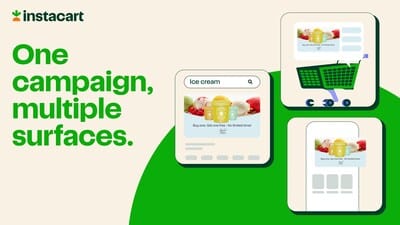
Shoppable Display Ads combine creative banner imagery with a carousel of 3 to 40 pinned products that shoppers can add directly to their cart. These ads appear inline on search results pages, browse pages, and—as of April 2025—on Caper Cart smart cart screens in physical stores. They operate on a first-price CPM auction with a minimum bid of $15 CPM.
What makes Shoppable Display uniquely powerful is its targeting flexibility. Beyond keyword targeting (which supports exact, narrow, and broad match types—unlike Sponsored Products’ exact-match-only system), advertisers can layer behavioral targeting based on purchase history, brand interactions, category engagement, and shopper recency. Pre-built behavioral shortcuts include segments like “New to Instacart,” “New to category/brand,” “Buys competitor but not my brand,” “Lapsed buyers,” and “Loyal buyers,” with lookback windows configurable from 30 to 180 days. The Caper Cart extension automatically syndicates Shoppable Display campaigns to in-store smart cart screens, with pilot data showing >3% engagement rates and >2% add-to-cart rates.
Shoppable Video Ads
Shoppable Video Ads deliver 3-to-30-second video content with integrated add-to-cart functionality and a product carousel. Videos auto-play when 50% visible, muted by default, and appear inline on search results and browse pages. Like Shoppable Display, they use a first-price CPM auction at a $15 CPM minimum and support the full range of keyword and behavioral targeting options.
Video is particularly effective for brands needing to communicate product quality, ingredients, or use cases—pet food brands like Reveal Pet Food have achieved double-digit ROAS with shoppable video campaigns. The format supports two campaign objectives: “Reach” (paired with behavioral targeting for maximum visibility) and “Engage” (paired with keyword targeting for high-intent moments).
Display Ads (non-shoppable banners)
Traditional banner ads without direct add-to-cart functionality appear on the homepage, department pages, aisle pages, and category pages. They click through to a brand landing page within the Instacart storefront. Display Ads use the same first-price CPM auction at $15 CPM minimum and support both keyword and behavioral targeting. These are best suited for upper-funnel brand awareness campaigns, particularly when paired with behavioral targeting to reach new-to-category shoppers or lapsed buyers.
Inspiration Ads: Recipes, Occasions, and Bundles
Instacart’s newest ad category, launched in open beta during 2024–2025, represents a strategic shift toward “out-of-aisle” discovery. These formats are designed to reach shoppers through contextual inspiration rather than direct search intent.
Sponsored Recipes are visual ad units featuring meal ideas with branded and complementary products. A pastry dough brand, for instance, might appear in a chicken pot pie recipe when a shopper searches for chicken. Pilot data showed 35%+ new-to-brand sales and 70% out-of-aisle impressions—meaning the ads reached shoppers who wouldn’t have encountered the product in their normal shopping path. Early partners include Mondelez, Hormel Foods, J.M. Smucker, and Barilla. JBSS (John B. Sanfilippo & Son) reported a $3.12 ROAS with 67% of attributed sales from new-to-brand customers during a holiday recipe campaign.
Occasions ads are curated product collections around themes like charcuterie boards, summer barbecue, spring cleaning, or Mother’s Day. Bundles pair complementary products for quick basket building—laundry detergent with dryer sheets and fabric softener, for example. Both formats are currently in pilot, with broader rollout planned through 2025–2026. A new “Out-of-Aisle Impressions %” metric launched in August 2025 helps advertisers measure the incremental reach of these discovery-oriented formats.
Promotions and Coupons
Digital brand coupons appear directly on applicable item tiles throughout the storefront, including beneath search results. Types include single-unit coupons, multi-unit coupons, and “Stock Up & Save” (minimum spend) coupons. The pricing model is pay-per-redemption—advertisers only pay when a coupon is actually redeemed. Once redeemed, a coupon becomes unavailable to that shopper for 30 days. If a retailer runs its own promotion on the same item, Instacart suppresses the brand coupon to prevent double-stacking. Promotions are available through both self-serve setup and managed service, and 88% of Instacart shoppers add more items when presented with promotions.
Hero Banners
Hero Banners are large, high-impact banner ads at the top of specific department or aisle pages. They are managed service only with fixed weekly pricing (not auction-based). Eligibility requirements are substantial: 80% of UPCs must be actively advertised through Sponsored Products, a minimum 7.5% reinvestment rate of total sales into SP advertising, pre-qualification for advanced reporting (requiring minimum spend of $15,000 per calendar quarter), and all Featured Product “Default” bids set to maximum suggested bid price.
Delivery Promotions
Delivery Promotions offer free delivery after shoppers add enough qualifying products to their cart, capitalizing on the fact that 24% of shoppers are willing to spend more to qualify for free shipping. These are managed service only, booked directly with Instacart representatives, and can be overridden by platform-wide delivery promotions. Alcohol items are excluded from delivery promotions.
Brand Pages
Brand Pages are free, fully customizable shoppable landing pages that showcase products, brand story, and collections. They serve as click-through destinations for Display, Shoppable Display, and Shoppable Video ads. Critically, Brand Pages have no organic discovery path—they are only accessible through paid media, making integration with ad campaigns essential. As of 2025, AI-Powered Landing Pages automatically generate product showcases and custom copy; Celsius reported a 20% increase in campaign-attributed sales using AI-generated landing pages. Best practice is to maintain at least one evergreen page plus dedicated seasonal pages, as seasonal Brand Pages consistently outperform evergreen across ad-to-cart rates, conversion, and new-to-brand performance.
Self-serve versus managed service at a glance
| Format | Self-Serve | Managed Only |
| Sponsored Products | ✅ | — |
| Shoppable Display | ✅ | — |
| Shoppable Video | ✅ | — |
| Display Ads | ✅ | — |
| Inspiration Ads (Recipes/Occasions/Bundles) | ✅ | — |
| Promotions/Coupons | ✅ | ✅ |
| Brand Pages | ✅ | — |
| Hero Banners | — | ✅ |
| Delivery Promotions | — | ✅ |
2. How the auction works: bidding mechanics and the Bid Landscape tool
The second-price auction for Sponsored Products
Instacart’s Sponsored Products use a second-price auction where the winning advertiser pays $0.01 above the next-highest bid—identical in concept to Amazon’s model. However, bid amount alone doesn’t determine the winner. The system factors in product relevance to the consumer’s search query, the likelihood a consumer will click on the ad, and overall ad quality signals. Each UPC carries its own quality score, with more popular product variants appearing more frequently.
The Default Maximum CPC bid applies across all auction placements—search results, browse pages, departments, aisles, Buy It Again, post-checkout, and item detail pages. Keyword Override bids allow advertisers to set custom CPCs for specific exact-match search terms, superseding the default bid for those terms only. This two-tier structure is central to Instacart bid management: savvy advertisers set the default bid low (at the $0.15–$0.30 minimum) to control auto-targeting spend, then layer higher override bids on their highest-value keywords.
The first-price auction for Display and Video
All display-based formats—Display Ads, Shoppable Display, and Shoppable Video—operate on a first-price CPM auction where the highest bid wins and pays the full bid amount. This makes bid efficiency more important than for Sponsored Products, as there’s no built-in discount mechanism. The minimum CPM across all display formats is $15.
The Bid Landscape tool
Instacart’s Bid Landscape tool, available within Ads Manager, uses historical platform data to estimate the impact of bid changes on spend, impressions, clicks, and sales over a projected 7-day window. The tool’s signature feature is its color-coded bid strength indicator:
- 🟢 Green: High probability of winning 50%+ of available placements
- 🟡 Yellow: High probability of winning ~25% of placements
- 🔴 Red: Low probability, below competitive threshold
This system updates in real-time as competitor bids shift, providing a dynamic view of auction competitiveness at both the ad group and individual keyword levels. For mid-to-high-velocity keywords, the color-coded system offers actionable guidance: aim for green on your highest-priority terms and accept yellow on lower-priority category terms where you want presence without premium spend.
Three bidding strategies to choose from
Manual CPC Bidding provides full control through default bids plus keyword overrides. Optimized Bidding with Target ROAS uses machine learning to dynamically adjust bids toward a specified return target, with a 3-to-7-day learning phase (Instacart recommends starting at a 3.0x ROAS target and adjusting). General Mills improved ROAS by approximately 50% using optimized bidding validated through A/B testing. Universal Campaigns, launched in March 2025, consolidate Sponsored Products and Shoppable Display into a single campaign with one budget, using advanced ML to auto-optimize across formats in real-time. Smart Budgeting, introduced in December 2025, adds automatic alignment of ad delivery with peak consumer shopping times.
3. Campaign architecture that actually works
The dual-campaign approach
The most effective Instacart advertisers run both optimized and manual CPC campaigns simultaneously. Optimized bidding campaigns yield the highest ROAS but tend to produce lower new-to-brand acquisition. Manual CPC campaigns deliver higher new-to-brand percentages but at lower ROAS. Running both in parallel balances efficiency with customer growth—a critical distinction for brands focused on long-term category share rather than short-term return.
Structuring campaigns by keyword intent
A tiered campaign structure organized by keyword type enables precise budget control and performance measurement:
- Brand Defense campaigns: Bid on your own brand terms at low budgets. Branded keywords deliver the highest ROAS and lowest CPCs (often near the $0.30 floor, signaling minimal competitive pressure). Allocate only a small portion of total budget here, as overspending on branded terms cannibalizes organic sales rather than driving incrementality.
- Category/Generic campaigns: These represent the largest growth opportunity on Instacart. Category keyword CPCs remain significantly lower than Amazon equivalents, and winning a customer on a generic term like “paper towels” or “Greek yogurt” has compounding value—the product appears in their “Your Items” section for all future orders, with 25% of all purchases originating from that section by a customer’s 10th order.
- Competitor Conquest campaigns: Accept lower ROAS targets here. Competitor keyword CPCs are “almost always higher than category keywords” with lower conversion rates. These campaigns work best for frequently purchased items where customer lifetime value justifies the higher acquisition cost, or as opportunistic plays when competitors experience out-of-stock situations.
Product grouping principles
Group products that share 70%+ of the same keywords into the same ad group. A lineup of tomato soup varieties sharing keywords like “tomato soup,” “canned soup,” and “soup” belongs together. Separately, group products within similar price tiers because the CPC you can afford relates directly to product price—higher average selling price (ASP) items can absorb higher bids while maintaining target ROAS. The most sophisticated advertisers combine both approaches: campaigns organized by category, with ad groups segmented by price tier within each category.
Each product can only belong to one campaign, preventing self-competition. Ad groups support up to 1,000 keywords each (with multiple ad groups per campaign) and have no limit on the number of SKUs.
Budget pacing: why “paced” always wins
Instacart offers two pacing options: Maximize Impressions (spends budget as fast as possible) and Paced Spending (distributes budget evenly across the campaign timeframe). Perpetua’s guidance is unequivocal: paced spending is “the only budget structure we recommend.” Maximize Impressions can deplete an entire campaign budget in hours, eliminating visibility during peak shopping periods later in the day or week. The only exception is for very low-traffic niche products where rapid spend is unlikely.
Instacart sends daily emailed reports flagging missed impressions due to budget caps, providing a natural feedback loop for budget optimization. Allow at least two weeks of data collection before making major optimization changes, and monitor campaigns two to three times per week.
Ten mistakes that drain Instacart budgets
- Ignoring auto-harvested keywords. Instacart continuously adds keywords it deems relevant to your products—at your default bid. Without active management, thousands of unwanted keywords accumulate and waste spend.
- Changing the default bid without reviewing keyword exposure. The default bid affects all non-keyword traffic and every auto-harvested keyword still at default. Always audit keyword-level bids before adjusting.
- Bidding on loosely related keywords. Bidding on “taco” keywords for a tequila brand shows poor performance—Instacart shoppers are deliberate, not impulsive. Relevancy drives conversion.
- Setting and forgetting. Instacart’s dynamic auction environment demands ongoing optimization.
- Not verifying product images and UPCs. Instacart-provided images can be outdated; out-of-stock products won’t receive impressions regardless of bid.
- Over-attributing sales to ads. When ad-attributed sales exceed 75% of total, attribution inflation is likely. Use market share and basket penetration as supplementary metrics.
- Neglecting upper-funnel formats. Most brands treat Instacart as a pure Sponsored Products/ROAS tool, missing full-funnel opportunities with display, video, and Brand Pages.
- Dayparting or frequently pausing campaigns. This degrades Instacart’s optimized bidding algorithm, which relies on continuous auction participation to calibrate predictions. Instacart shoppers fill carts throughout the week.
- Not linking campaigns to Brand Pages. Brand Pages have zero organic discoverability—only paid media drives traffic there.
- Ignoring competitive intelligence. Conduct digital “store walks” to identify low-competition keywords with attractive CPCs for display and video campaigns.
4. Instacart keyword research from first bid to full optimization
Exact match only: the fundamental difference
Instacart’s keyword system differs from Amazon and Google in three critical ways. First, Instacart only supports exact-match keywords for Sponsored Products. Bidding on “tomato soup” targets only that exact phrase—not “organic tomato soup” or “tomato soup cans.” Second, negative keywords do not exist on the platform. The only workaround is reducing unwanted keyword bids to the $0.15–$0.30 minimum. Third, keywords cannot be paused or deleted once added to a campaign—they can only have their bids minimized. These constraints make deliberate, strategic keyword selection far more important on Instacart than on other platforms.
For Shoppable Display, Shoppable Video, and Display Ads, Instacart offers three match types: exact, narrow, and broad (with broad as default). This expanded matching is only available for display-format campaigns, not Sponsored Products.
The keyword harvesting workflow
First, try out RMIQ’s Instacart Keyword Tool to research relevant keywords for your own campaign. The most reliable keyword discovery process follows a structured pipeline, as per below.
Step 1 — Launch a campaign with the default bid set to the minimum ($0.15–$0.30) and add your known high-performing keywords with higher override bids. Within 24–48 hours, Instacart’s algorithm auto-populates organic search terms relevant to your products based on network-wide behavioral data.
Step 2 — Analyze auto-harvested keywords weekly (not daily, given the 14-day attribution window). Identify converting search terms with strong ROAS and graduate them to manual keywords with dedicated override bids. Reduce bids to the minimum on irrelevant or low-performing terms.
Step 3 — Cross-pollinate from Amazon. Filter your Amazon campaigns by high ROAS and impression volume, then export top search queries (not keywords, since Instacart uses exact match). These translate directly to Instacart keyword targets.
Step 4 — Explore long-tail opportunities through dietary keywords (keto, gluten-free, plant-based), occasion-based terms (“party essentials,” “game day snacks”), and recipe-driven searches. Instacart search is dominated by a small set of head terms, but long-tail queries often carry lower CPCs and higher conversion rates.
Keyword bidding by type
| Keyword Type | Typical CPC Range | Expected ROAS | Budget Share | Strategic Role |
| Branded | $0.30–$0.60 | 5x–8x+ | 10–15% | Brand defense, prevent competitor capture |
| Category/Generic | $0.50–$1.20 | 2x–4x | 50–60% | Primary growth driver, customer acquisition |
| Competitor Conquest | $1.00–$2.00+ | 1x–2.5x | 15–25% | Customer acquisition from rivals, OOS capture |
| Long-Tail/Dietary | $0.30–$0.80 | 3x–5x | 10–15% | Niche targeting, high conversion efficiency |
The compounding value of winning keywords early
A dynamic unique to Instacart makes keyword strategy particularly consequential: the “Buy It Again” flywheel. When a customer first purchases your product (regardless of whether it was through a paid or organic impression), that product enters their “Your Items” list. By a customer’s 10th order, approximately 25% of their purchases originate from this section. This means winning a single keyword-driven conversion creates recurring organic impressions indefinitely—a powerful argument for investing aggressively in category keywords early, even at lower initial ROAS targets.
5. ROAS benchmarks and the metrics that matter
Where Instacart fits in the retail media ROAS hierarchy
Instacart’s average grocery ROAS of $5.25 (H1 2025, Pacvue data) positions it favorably against the broader retail media landscape. Among grocery-focused platforms, only Walmart ($13.46) and Sam’s Club ($13+) deliver higher returns—driven by their massive scale advantages. Instacart outperforms both Amazon ($4.92) and approximates Target ($5.77) for grocery categories.
| Platform | Grocery ROAS (H1 2025) |
| Walmart | $13.46 |
| Sam’s Club | $13+ |
| Target | $5.77 |
| Instacart | $5.25 |
| Amazon | $4.92 |
Category-specific ROAS varies significantly. Branded keyword campaigns on Instacart regularly achieve 5x–8x+ ROAS, while unbranded category campaigns typically land in the 2x–4x range. CPG clients working with agencies like Mindstream report average ROAS of 3.5x, scaling to 5.4x during focused pushes. Reveal Pet Food reports “double-digit ROAS” from shoppable video campaigns. JBSS achieved $3.12 ROAS on Sponsored Recipe campaigns—strong for an awareness-oriented format—with 67% of sales from new-to-brand customers.
CPC trends signal a maturing platform
Instacart’s average CPC has been trending steadily upward: +0.6% year-over-year in Q1 2025, accelerating to +4.9% quarter-over-quarter in Q3 2025. The platform’s effective CPM has grown approximately 30% since April 2022. Despite this inflation, Instacart CPCs remain materially lower than Amazon for equivalent grocery and CPG keywords—Perpetua notes that category keywords “can be won with a CPC much lower than what you would see on Amazon.” Amazon’s Health & Household CPC ($2.23) is roughly double Instacart’s equivalent category range.
In the early launch period (2020–2021), keyword bids on Instacart were up to 10x cheaper than Amazon. That gap has narrowed significantly as advertiser adoption grows (ad spend +13% QoQ in Q3 2025), but the cost advantage persists—representing a window for brands to establish keyword positions before further price convergence.
The 14-day attribution window and multi-touch model
Instacart uses a 14-day post-click attribution window across all ad formats. Since August 2022, the default attribution model has been linear multi-touch, distributing purchase credit across all advertising touchpoints a consumer interacted with before buying. Last-touch attribution remains available as a secondary view for comparison. Display and video ads additionally support view-through attribution, measuring sales that occur after an ad view without a click.
Instacart’s attribution is MRC-accredited for impressions and clicks (both gross and net, filtered for invalid traffic). The platform also supports randomized control tests for incrementality measurement, allowing advertisers to isolate the true causal impact of their campaigns beyond what attribution models capture.
Beyond ROAS: Instacart’s unique metrics ecosystem
Instacart offers several metrics that don’t exist on other advertising platforms, reflecting its position as a closed-loop grocery purchase environment:
New-to-Brand (NTB) Sales measures revenue from consumers who haven’t purchased from your brand in the last 26 weeks (shorter than Amazon/Walmart’s lookback windows). NTB purchases average 45–60% of total ad-attributed sales, making this metric critical for assessing customer acquisition. NTB Halo Sales extends this to related products within the same brand family.
Basket Penetration tracks the percentage of all Instacart baskets containing your brand’s product—the single best measure of habitual purchasing. Customer Share % measures the percentage of unique customers who purchased from your brand in a given category, while Basket Share % measures the percentage of unique deliveries containing your product. Both are available through Instacart’s Insights Center.
Halo ROAS captures attributed sales of related products outside the specific campaign (different flavors, pack sizes, or varieties), revealing the full brand impact of advertising beyond directly promoted SKUs. Incremental ROAS (iROAS) measures only the additional revenue directly caused by ads versus what would have occurred organically.
Share of Shelf combines organic and paid presence into a single visibility metric, available natively in Instacart’s tools. Pacvue extends this with unblinded competitive share of voice at the keyword and retailer level.
Advanced reporting tiers require minimum quarterly spend thresholds: $10,000+ per quarter with a 5% reinvestment rate unlocks basket penetration, regional sales, out-of-stock rates, sales decomposition, and new customer conversion data.
6. Instacart versus Amazon versus Google: a direct comparison
The three platforms serve fundamentally different roles in a media strategy, and understanding their structural differences helps allocate budgets effectively.
| Dimension | Instacart | Amazon | |
| Average CPC | $0.50–$1.00 (SP) | $1.04–$1.12 (SP) | $5.26 (Search); $0.90–$1.30 (Shopping) |
| Average ROAS | $5.25 (grocery) | $4.92 (grocery); ~3.3x overall | 2x–4x (e-commerce) |
| Attribution window | 14 days | 7–14 days (up to 28 via AMC) | 30–90 days configurable |
| Attribution model | Linear multi-touch (default) | Last-touch (default) | Data-driven (default) |
| Keyword match types | Exact only (SP); 3 types (Display) | Broad, phrase, exact, negative | Broad, phrase, exact, negative |
| Audience reach | 14.4M monthly active users | 300M+ active customers globally | 4.3B+ users across Google network |
| Purchase intent | Highest (active grocery shopping) | Very high (marketplace buyers) | Mixed (search = high; display = low) |
| Conversion rate | >50% of searches → cart addition | 9.5–10.5% overall | 7.52% average (search) |
| 1st-party purchase data | ✅ Deterministic, logged-in | ✅ Extensive purchase + browse | ⚠️ Limited; relies on intent signals |
| Closed-loop measurement | ✅ Full funnel visibility | ✅ Within Amazon ecosystem | ❌ Requires additional tracking |
| Self-serve minimum | No minimum | No minimum (DSP: $10K+/mo) | No minimum |
| Category strength | Grocery, CPG, household, pet, alcohol | Electronics, home, beauty, fashion | All industries; services, B2B, SaaS |
| Negative keywords | ❌ Not supported | ✅ Supported | ✅ Supported |
| Auction model | 2nd-price (SP); 1st-price (display) | 2nd-price | Generalized 2nd-price (Ad Rank) |
Where Instacart wins
First-party purchase data quality is Instacart’s decisive advantage. Every user is logged in, with a verified delivery address, completing real grocery transactions across 1,800+ retailers. This deterministic, transaction-level data powers not just on-platform targeting but also off-platform activation through partnerships with Google, YouTube, Meta, TikTok, Pinterest, The Trade Desk, and Roku. As third-party cookies deprecate, this first-party data moat deepens.
Purchase intent concentration on Instacart is unmatched. Users arrive specifically to shop—not browse, research, or compare. The average order involves 20 searches, with over 50% resulting in a cart addition. Approximately 80% of purchases come from products in the first 1–3 rows of search results, making top placement extraordinarily valuable.
The “Buy It Again” flywheel creates lifetime customer value from a single conversion. Grocery is inherently habitual—once a product enters a shopper’s reorder list, it generates recurring organic impressions and repeat purchases indefinitely.
Where Instacart falls short
Scale remains the primary limitation. At 14.4 million monthly active users, Instacart reaches roughly 5% of Amazon’s customer base and a fraction of Google’s. Total ad revenue of approximately $1 billion trails Amazon’s $47+ billion and Google’s $237+ billion. For brands seeking mass awareness, Instacart alone is insufficient.
Limited campaign controls present operational friction. No negative keywords, no ability to delete keywords once added, exact-match-only targeting for Sponsored Products, and historically no retailer-level targeting or performance breakdowns constrain optimization compared to Amazon’s mature toolset. Advanced metrics remain gated behind spending thresholds.
Narrower category breadth means Instacart excels for CPG, grocery, pet, alcohol, and household products but offers limited value for electronics, fashion, or non-consumable categories where Amazon and Google dominate.
Rising costs present a strategic consideration. CPCs have increased roughly 30% since mid-2022, and the current trajectory of +4.9% QoQ acceleration suggests the platform’s early-mover cost advantage is eroding. Brands should establish keyword positions now before further convergence with Amazon pricing.
7. Category playbooks for CPG, alcohol, pet, food, health, and household
CPG and grocery: the core playbook
Grocery is Instacart’s heartland, and the strategies here apply broadly across CPG categories. Budget allocation should follow a tiered approach: conservative brands invest 2–5% of Instacart revenue in advertising, focusing on breakeven ROAS; moderate brands balance growth and profitability; aggressive brands invest 6–20% of revenue, prioritizing new-to-brand acquisition and category share growth. Typical daily spend ranges from $300 to $1,000+ at launch, scaling based on performance.
The most critical KPIs for CPG are category share and basket penetration—not ROAS alone. Winning a first purchase matters disproportionately because of the Buy It Again flywheel, so accept lower ROAS on acquisition-focused campaigns in exchange for long-term repeat purchase revenue. Stack ad types together: Sponsored Products for bottom-funnel conversion, Shoppable Display for mid-funnel consideration, and Video for upper-funnel brand storytelling. Club-sized SKUs (Costco packs) perform particularly well on Instacart.
Leading CPG advertisers on the WARC dComm Index include Tide (Household), Coffee Mate (Non-Alcoholic Drinks), Similac (Baby), Oral-B (Beauty/Personal Care), and Philadelphia (Food). Major players like P&G, Unilever, PepsiCo, Mondelez, and Hormel Foods maintain active, multi-format Instacart programs.
Alcohol advertising: navigating state-by-state regulations
Alcohol represents one of Instacart’s most compliance-intensive categories. While Instacart delivers alcohol in 23+ states and Washington D.C., advertising availability is more restrictive than delivery permissions—a state allowing alcohol delivery does not automatically allow alcohol advertising, as these fall under different regulatory frameworks.
The original 14 states plus D.C. where Instacart expanded alcohol delivery include California, Connecticut, Florida, Illinois, Kentucky, Massachusetts, Minnesota, Missouri, North Carolina, Ohio, Oregon, Texas, Virginia, Washington, and Washington D.C. The full current advertising-eligible state list fluctuates and should be confirmed directly with Instacart’s ad team, as control states (where state agencies control liquor sales, such as Pennsylvania, Utah, and others) often impose stricter advertising regulations, and three-tier system restrictions in other states may limit digital alcohol promotion.
Key compliance requirements include: all ads must comply with applicable federal, state, and local laws; no references to excessive drinking; no claims of improved social, mental, or athletic performance; ads are automatically geo-restricted to permitted regions; minimum age of 21+ for all alcohol orders; and ID verification (government-issued photo ID scanned at delivery) is mandatory. California requires digital ID scanning specifically, with no manual entry permitted.
The August 2025 Instacart × Bottlecapps partnership significantly expanded alcohol advertising inventory by bringing Carrot Ads to Bottlecapps’ network of 1,300+ alcohol retailers, allowing brands to extend Instacart campaigns across specialized alcohol e-commerce storefronts. This, combined with The Trade Desk integration offering ready-made alcohol audience segments, represents a material expansion of the alcohol advertising opportunity.
Best practices for alcohol brands: focus on category keywords (“red wine,” “IPA,” “tequila”) over branded terms; leverage occasion-based marketing around holidays and game days; ensure rigorous compliance review of all creative; and prioritize getting products into shoppers’ “Buy It Again” lists, as the alcohol category remains relatively under-penetrated by advertisers compared to food and beverage.
Pet industry: leveraging Instacart’s unique retail breadth
Instacart is the only online marketplace featuring all five of the top U.S. pet retailers, including Pet Supplies Plus (700+ stores, 11,000+ products added in October 2025), Petco, and PetSmart. This positions the platform uniquely for pet brands seeking broad distribution reach.
Pet products benefit from extremely high repeat purchase rates—pet food and treats are among the most habitual categories in grocery. Reveal Pet Food, an early Instacart advertiser since 2022, has achieved double-digit ROAS primarily through shoppable video campaigns that showcase product quality and ingredients. The top-selling dog treat brands on Instacart are Milk-Bone, Heart to Tail, Purina Beggin’, Good ‘n’ Fun, and Pup-Peroni; top cat treat brands include Temptations, Purina Friskies, and Delectables.
Strategy for pet brands should emphasize shoppable video to communicate ingredient quality and product differentiation; target category keywords aggressively (competition remains lower than in food/beverage); and focus on converting first-time buyers who will generate recurring purchases through the Buy It Again flywheel.
Food and beverage: unlocking Sponsored Recipes and occasion targeting
Food and beverage brands have the richest set of Instacart-specific tools at their disposal. Sponsored Recipes represent the highest-impact innovation for this category—brands embed their products into meal inspiration content that appears when shoppers search for complementary ingredients. Mondelez tested Chips Ahoy! Ice Cream Pops, Hormel featured Jennie-O Turkey Spinach Lasagna, and J.M. Smucker promoted Caramel Apple Pie Cold Brew.
Off-platform, Instacart has launched Shoppable Recipes with TikTok (the first grocery platform to integrate), Tasty, and Hearst Magazines (Delish, Good Housekeeping, Pioneer Woman)—Hearst properties alone drive approximately 56 million monthly recipe page views. Creators earn payouts based on engagements and orders placed.
Seasonal and occasion-based strategies are particularly potent for food and beverage. Build campaigns around game day, summer BBQ, back-to-school, and the Thanksgiving-through-New Year’s corridor. Rotate keywords seasonally—terms that perform well in July may underperform in November—and use the 1,000 keyword per ad group limit strategically by swapping seasonal terms in and out.
Health, beauty, and household: expanding beyond grocery’s core
Health and Household carries the highest CPCs among all CPG verticals on Amazon ($2.23 average), making Instacart’s lower-cost environment particularly attractive for this category. The platform has expanded significantly into beauty through partnerships with Sephora and other retailers, and Elizabeth Marsten of Tinuiti notes that “customers are moving rapidly from perishable staples to adding CPG products like cosmetics, health, and alcohol.”
Household products benefit from Instacart’s strongest repeat-purchase dynamics. Items like laundry detergent, paper towels, and cleaning supplies are purchased weekly and habitually—making the “Buy It Again” section disproportionately valuable. Tide leads the WARC dComm Index for the Household category on Instacart. The new Bundles ad format pairs complementary household products (detergent + fabric softener + dryer sheets) to drive basket-building and cross-category sales.
For both categories, prioritize getting products into shoppers’ first orders through competitive category keyword bidding and strategic coupon use. The lifetime value of a household product customer who adds your item to their habitual reorder list far exceeds the initial acquisition cost.
8. The 2025–2026 innovation wave reshaping Instacart advertising
Caper Carts bring digital ads into physical aisles
Instacart’s most ambitious innovation is the extension of digital advertising into physical stores through Caper Cart smart carts—AI-powered shopping carts with integrated screens that display ads as shoppers navigate store aisles. Piloted at Bristol Farms in January 2024 and expanded to all 7,000+ brand partners by April 2025, Caper Cart ads are aisle-aware (displaying only when the cart is in a relevant aisle) and inventory-aware (showing only in-stock items).
Retail partners include ALDI, Kroger, Schnucks, Wakefern, and Good Food Holdings, with availability across 60+ U.S. cities. Average shopping sessions exceed 30 minutes per Caper Cart use, with a Net Promoter Score above 70. The 2025 integration of NVIDIA Jetson chips enables personalized product recommendations based on real-time location, cart contents, and shopping history. Shoppable Display campaigns automatically extend to Caper Cart screens when keyword targeting or optimized performance is enabled, using the same first-price CPM auction (charged when an ad displays for 1 second).
Carrot Ads: building retail media networks at scale
Instacart’s Carrot Ads white-label technology enables retailers to build their own advertising networks powered by Instacart’s ad infrastructure. With 240+ retail partners (including Sprouts, Schnucks, Thrive Market, Hy-Vee, Bottlecapps, and Vroom Delivery’s 3,500 convenience stores), Carrot Ads reaches 7,500+ CPG brand advertisers. Schnucks reported 2.6% click-through rates, 5.7x average ROAS, and a 7x increase in retail media revenue using the platform. In November 2025, Carrot Ads expanded its MRC accreditation to cover placements across desktop, mobile web, and mobile app in the U.S. and Canada. The April 2025 Uber partnership extended Carrot Ads to power Uber Eats’ Sponsored Items for CPG advertisers.
Retail Powered Media takes Instacart data off-platform
The most strategically significant development is Instacart’s Retail Powered Media (RPM) program, which leverages first-party purchase data to power advertising across external platforms:
| Partner | Launch | Mechanism |
| Google Shopping | Jan 2024 | Shopping ads with Instacart 1P targeting; click → Instacart product page |
| YouTube | Jun 2024 | Shoppable video ads with closed-loop measurement; Hershey reported 4x ROAS |
| Meta (Facebook/Instagram) | 2024 | Catalog ads powered by Instacart purchase data |
| The Trade Desk | 2024–2025 | Self-serve programmatic with daily refreshed sales data; McCormick reported strong results |
| PubMatic | Apr 2024 | Programmatic across 1,700+ publisher network |
| Roku | 2024 | CTV advertising; Hershey saw 4x ROAS with Roku + Instacart data |
| Jun 2025 | Direct shoppability with 30-min delivery; closed-loop measurement in Phase 2 | |
| TikTok | Oct 2025 | Ads Manager integration with 1P data targeting and conversion measurement |
This off-platform expansion transforms Instacart from a single advertising destination into a data-powered media network that competes with Amazon’s DSP and Google’s first-party data ambitions. Offsite retail media ad spending grew 42% year-over-year from 2024 to 2025.
The Instacart Developer Platform opens new commerce surfaces
Launched in March 2024, the Instacart Developer Platform (IDP) provides public APIs enabling third parties to integrate Instacart’s cart-building, fulfillment, and product search capabilities into their own websites and apps. Partners include New York Times Cooking, WeightWatchers, GE Appliances, and a growing roster of recipe, wellness, and meal-planning apps. The platform offers access to 1 billion+ shoppable products from 85,000+ stores, real-time product availability and pricing, and ingredient matching for recipes. For advertisers, IDP creates new surfaces where consumers build Instacart carts—each representing an additional opportunity for ad exposure and product discovery.
9. Building a multi-format, full-funnel Instacart strategy
When to expand beyond Sponsored Products
Most brands begin with Sponsored Products, and for good reason—it’s the format with the most direct path to measurable ROAS. The decision to expand into display and video should be triggered by specific signals: you’ve captured strong branded keyword positions, your category keyword campaigns are hitting ROAS targets consistently, and you want to grow new-to-brand acquisition beyond what search-based targeting can deliver.
The expansion path follows a logical sequence. First, add Shoppable Display with behavioral targeting to reach shoppers who buy in your category but haven’t tried your brand. Second, layer in Shoppable Video to communicate product stories, ingredients, or use cases that static images can’t convey. Third, build dedicated Brand Pages (both evergreen and seasonal) to serve as landing page destinations. Fourth, test Sponsored Recipes for “out-of-aisle” discovery if you’re in food and beverage. Finally, consider off-platform activation through The Trade Desk or direct RPM partnerships if you have the budget for upper-funnel reach.
Stacking formats compounds impact: Tinuiti’s work with Poppi demonstrated that a full-funnel approach across ad types increased first-time buyers by 269% and repeat buyers by 704%, with basket penetration growing 50% week-over-week. Wild Planet achieved a 54% surge in new-to-brand purchases and grew market share by 2 points to approximately 14%.
Geographic and seasonal optimization
Instacart serves ads based on geographic product availability and real-time stock levels—if a product isn’t available at nearby retailers for a given shopper, the ad won’t serve. This means distribution strategy and inventory management are prerequisites for advertising success, not separate functions. Ensure products are in stock at high-distribution regions before allocating significant ad budgets.
Dayparting is not recommended on Instacart. Unlike platforms where shopping concentrates in specific windows, Instacart shoppers fill carts throughout the day and week, checking out when ready. Frequently pausing campaigns degrades the optimized bidding algorithm’s prediction accuracy. Instead, use Instacart’s December 2025 Smart Budgeting feature, which automatically aligns ad delivery with peak shopping times without manual intervention.
Seasonal strategy should be proactive: build seasonal Brand Pages in advance, create recipe-based campaigns tied to holidays and occasions, and adjust keyword portfolios to match seasonal search patterns. The highest-performing seasonal activations combine Sponsored Products with Shoppable Display, dedicated seasonal Brand Pages, and occasion-appropriate coupon offers.
The brands winning on Instacart in 2025 and 2026 are not simply running Sponsored Products campaigns. They’re building integrated, full-funnel programs that combine keyword-targeted search placements with behavioral display targeting, video storytelling, recipe-based discovery, strategic coupon deployment, and off-platform audience extension—all measured through Instacart’s closed-loop attribution and incrementality testing. The window for establishing dominance at today’s cost structure is narrowing, but it remains open.