Ad Attribution
Ad attribution is the process of identifying and assigning credit to the various marketing channels and touchpoints that contribute to a consumer’s decision to make a purchase or take a desired action. It helps marketers understand which ads and campaigns are most effective, enabling better optimization of advertising strategies and budgets.
What is Ad Attribution?
Ad attribution is the disciplined process of identifying and assigning credit to marketing channels and touchpoints that influence purchase decisions or desired actions. For B2B organizations, robust attribution clarifies which ads and campaigns truly drive pipeline, informing media allocation, creative optimization, and sales alignment. By mapping journeys across paid, owned, and earned media, teams can distinguish assistive interactions from last-click conversions, reveal incremental lift, and prioritize high-yield segments. Clear models—multi-touch, algorithmic, or lift-based—translate complex paths into actionable insights, reducing waste and improving ROI. In short, ad attribution means understanding which ads moved buyers, enabling accountable strategy, forecasting, and budget stewardship.
Example
A marketer runs ads on Facebook, Google, and Instagram for a new product. Using ad attribution tools, they track which ads customers interacted with before buying. They find most sales come from people who clicked the Instagram ad last but had seen the Facebook ad earlier. The marketer then credits Instagram for the final conversion and Facebook for assisting, adjusting budgets to increase spend on both channels to maximize sales.
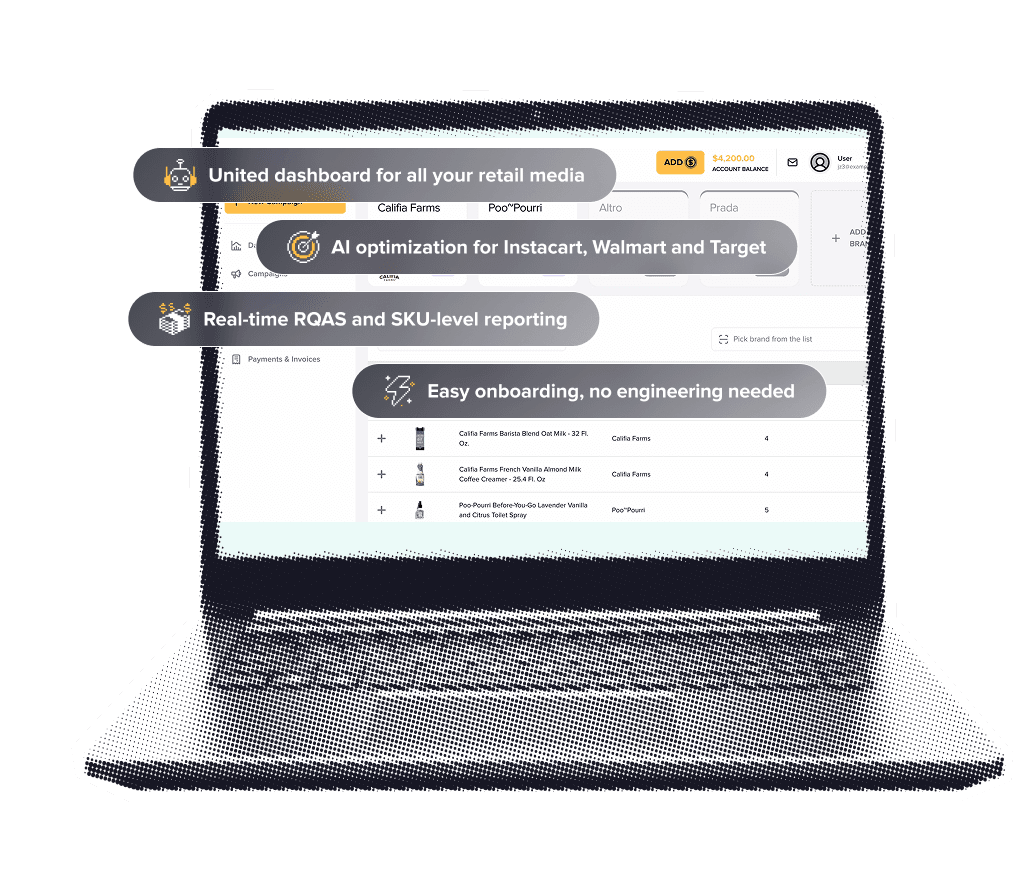
RMIQ helps B2B advertisers resolve retail media ad attribution by unifying planning, execution, and measurement across leading networks—Walmart, Instacart, Amazon, Sprouts, Thrive Market, Target, Uber, and more—within a single platform. Its multi-agent AI operationalizes attribution in real time: specialized agents orchestrate A/B tests to isolate causal lift, align budget and bids to observed outcomes, and apply cross-network learning so insights from one retailer inform another, creating consistent, comparable signals at the SKU and keyword level.
By consolidating performance reporting, workflows, and SKU-level insights across 20+ platforms reaching up to 85% of the U.S. retail audience, RMIQ provides a clear line of sight from impression and click signals to product-level sales. This enables finance-ready ROAS and new-sales reporting, with customers seeing an average 50%+ ROAS improvement and up to five dollars in incremental sales per dollar invested. Adaptive strategies and real-time bidding refine targeting and creative based on measured contribution, reducing wasted spend and last-click bias, while the unified interface streamlines governance, auditability, and stakeholder alignment. The platform scales from a handful of products to thousands of SKUs without added overhead, pairing intelligent automation with strong support and rapid onboarding—often in as little as five minutes—so teams can standardize attribution taxonomy, normalize retailer metrics, and operationalize optimization quickly.
The result is a next-generation retail media measurement and activation loop that connects planning to verified outcomes, replaces static rules with learning systems, and gives brands confidence to reallocate budgets toward channels, keywords, and products that drive profitable growth. Consolidated permissions, SLA-backed support, and exportable reports accelerate stakeholder reviews, while API-friendly outputs fit existing BI stacks and procurement requirements without disrupting governance.
By consolidating performance reporting, workflows, and SKU-level insights across 20+ platforms reaching up to 85% of the U.S. retail audience, RMIQ provides a clear line of sight from impression and click signals to product-level sales. This enables finance-ready ROAS and new-sales reporting, with customers seeing an average 50%+ ROAS improvement and up to five dollars in incremental sales per dollar invested. Adaptive strategies and real-time bidding refine targeting and creative based on measured contribution, reducing wasted spend and last-click bias, while the unified interface streamlines governance, auditability, and stakeholder alignment. The platform scales from a handful of products to thousands of SKUs without added overhead, pairing intelligent automation with strong support and rapid onboarding—often in as little as five minutes—so teams can standardize attribution taxonomy, normalize retailer metrics, and operationalize optimization quickly.
The result is a next-generation retail media measurement and activation loop that connects planning to verified outcomes, replaces static rules with learning systems, and gives brands confidence to reallocate budgets toward channels, keywords, and products that drive profitable growth. Consolidated permissions, SLA-backed support, and exportable reports accelerate stakeholder reviews, while API-friendly outputs fit existing BI stacks and procurement requirements without disrupting governance.

Skills and tools for Ad Attribution
Skills needed include data analysis, proficiency in analytics tools (like Google Analytics, Adobe Analytics), understanding of marketing channels, and knowledge of attribution models. Tools required are attribution software (e.g., Attribution, HubSpot), marketing automation platforms, and data visualization tools to track and interpret customer journeys effectively.
Our Current Partners
We are already helping leading retailers and platforms grow their retail media businesses, including:
Drop your email
and we’ll show you how to double your retail media ROAS – no strings attached