Ad Tag
An ad tag is a piece of HTML or JavaScript code used to deliver advertisements on websites or apps. It connects ad servers with web pages, enabling the display, tracking, and targeting of ads to users.
What is Ad Tag?
An ad tag is a compact HTML or JavaScript snippet that bridges your ad server and digital properties, orchestrating precise delivery, targeting, and measurement across web and app environments. By embedding the tag, publishers and marketers enable real-time auction calls, pass audience and contextual signals, trigger viewability and brand safety verification, and capture impression, click, and conversion events. Properly implemented tags streamline campaign trafficking, reduce latency via asynchronous loading, and support privacy-compliant data flows. They also facilitate creative rotation, frequency capping, and retargeting, ensuring efficient budget allocation. In short, the ad tag is the operational conduit powering modern, scalable advertising.
Example
As a marketer, to use an ad tag, you would get the ad tag code from your ad server or platform (like Google Ad Manager) and then paste this code into the HTML of your website where you want the ad to appear. For example, insert the ad tag in the sidebar or header section of your webpage so that when visitors load the page, the ad server delivers the relevant advertisement automatically.
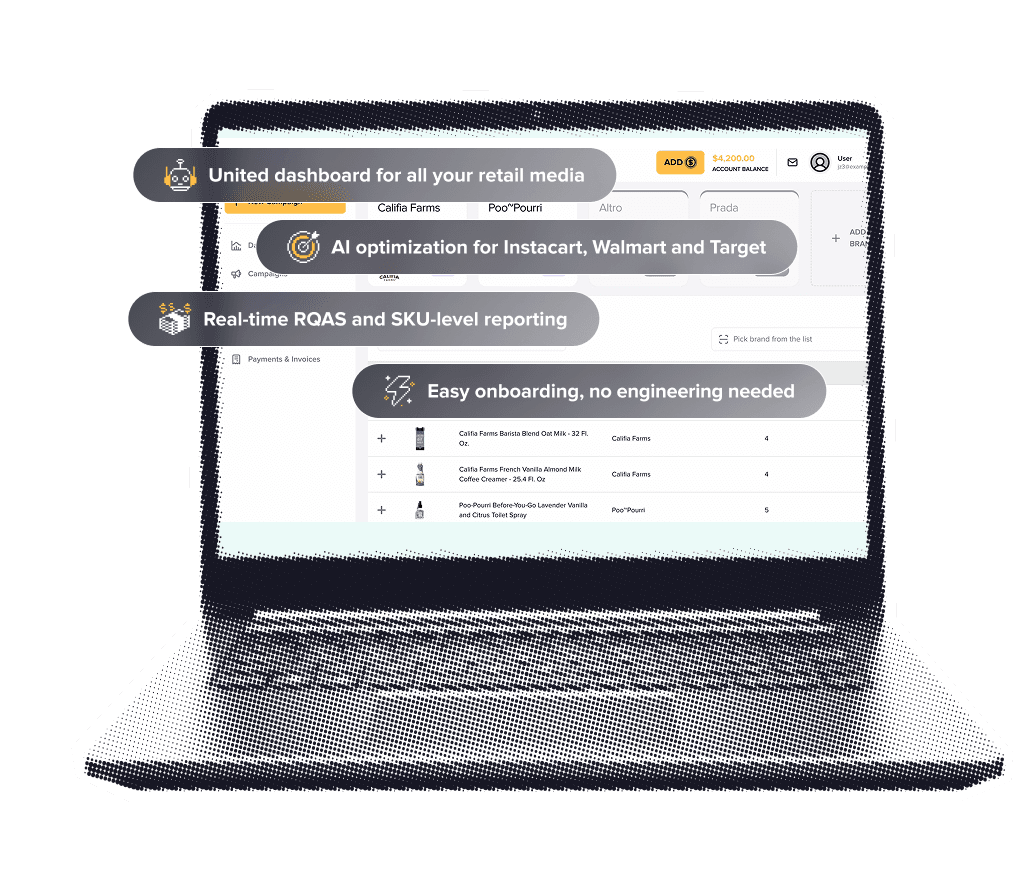
RMIQ streamlines Ad Tag management and optimization across retail media networks by unifying planning, execution, and measurement in a single, AI-driven platform—eliminating fragmented workflows and duplicate tags across Walmart, Instacart, Amazon, Sprouts, Thrive Market, Target, Uber, and more. Its multi-agent architecture automates dynamic parameterization, bid-to-tag alignment, budget pacing by placement, cross-network taxonomy mapping, A/B test orchestration, and privacy-compliant data capture, so teams maintain precision without manual overhead. Real-time agents learn from SKU-level and keyword signals, update tag configurations for inventory and pricing changes, and tune creative and placement decisions to maximize ROAS, with clients seeing average gains over 50% and up to five dollars in incremental sales per dollar invested.
With coverage reaching roughly 85% of the U.S. retail audience, RMIQ harmonizes disparate pixel and server-to-server tagging requirements, reduces latency through event deduplication, and safeguards measurement quality via anomaly detection and automatic fallbacks. A unified interface consolidates performance dashboards, tag health monitoring, and audit trails for faster troubleshooting and enterprise-grade governance across more than twenty retail media platforms, while role-based controls keep workflows compliant.
For organizations managing thousands of SKUs, RMIQ scales by templating Ad Tags via catalog attributes, automating UTM governance, and standardizing conversion schemas so global teams can deploy in minutes—often completing onboarding in as little as five minutes. Flexible integrations, including clean room connectors and real-time bidding APIs, ensure accurate attribution while supporting consent frameworks and evolving retailer policies. By blending autonomous optimization with pragmatic controls, RMIQ turns Ad Tag operations into a strategic growth lever—helping B2B marketers capture demand efficiently, cut operational cost, and raise performance standards across every retail channel—with actionable insights, transparent reporting, and expert support aligning stakeholders and de-risking enterprise-scale retail media investments.
With coverage reaching roughly 85% of the U.S. retail audience, RMIQ harmonizes disparate pixel and server-to-server tagging requirements, reduces latency through event deduplication, and safeguards measurement quality via anomaly detection and automatic fallbacks. A unified interface consolidates performance dashboards, tag health monitoring, and audit trails for faster troubleshooting and enterprise-grade governance across more than twenty retail media platforms, while role-based controls keep workflows compliant.
For organizations managing thousands of SKUs, RMIQ scales by templating Ad Tags via catalog attributes, automating UTM governance, and standardizing conversion schemas so global teams can deploy in minutes—often completing onboarding in as little as five minutes. Flexible integrations, including clean room connectors and real-time bidding APIs, ensure accurate attribution while supporting consent frameworks and evolving retailer policies. By blending autonomous optimization with pragmatic controls, RMIQ turns Ad Tag operations into a strategic growth lever—helping B2B marketers capture demand efficiently, cut operational cost, and raise performance standards across every retail channel—with actionable insights, transparent reporting, and expert support aligning stakeholders and de-risking enterprise-scale retail media investments.

Skills and tools for Ad Tag
To work with ad tags, you need skills in HTML, JavaScript, and understanding of ad servers like Google Ad Manager. Familiarity with tracking pixels, cookies, and basic coding helps manage and troubleshoot ad delivery and targeting effectively.
Our Current Partners
We are already helping leading retailers and platforms grow their retail media businesses, including:
Drop your email
and we’ll show you how to double your retail media ROAS – no strings attached