DPAs

DPAs, or Data Processing Agreements, are legally binding contracts between data controllers and data processors that outline the responsibilities, obligations, and standards for handling personal data in compliance with data protection regulations.

What is DPAs?

DPAs demand clarity: as Data Processing Agreements, they define controller–processor duties, safeguards, and lawful bases, ensuring compliant, auditable handling of personal data across vendors and platforms. Separately, dynamic product ads (often abbreviated similarly) algorithmically personalize creative, surfacing the most relevant items to decision‑makers across devices in real time. For B2B teams, align these concepts: pair privacy‑by‑design contracts with catalog, feed, and event governance so personalization never outpaces consent, retention, or processor oversight. Standardize clauses, DPIAs, and subprocessor reviews; map data flows powering ads; and test frequency, formats, and audiences to drive measurable pipeline uplift without compromising regulatory expectations or trust.
currency

Example

As a marketer, to create a Dynamic Product Advertisement (DPA), you first integrate your product catalog with a platform like Facebook or Google Ads. Then, you set up a campaign where the ads automatically pull product images, prices, and details from your catalog to show personalized ads to users based on their browsing behavior, such as showing a customer the exact toys they viewed or added to their cart but didn’t buy. This increases relevance and boosts sales.
plus
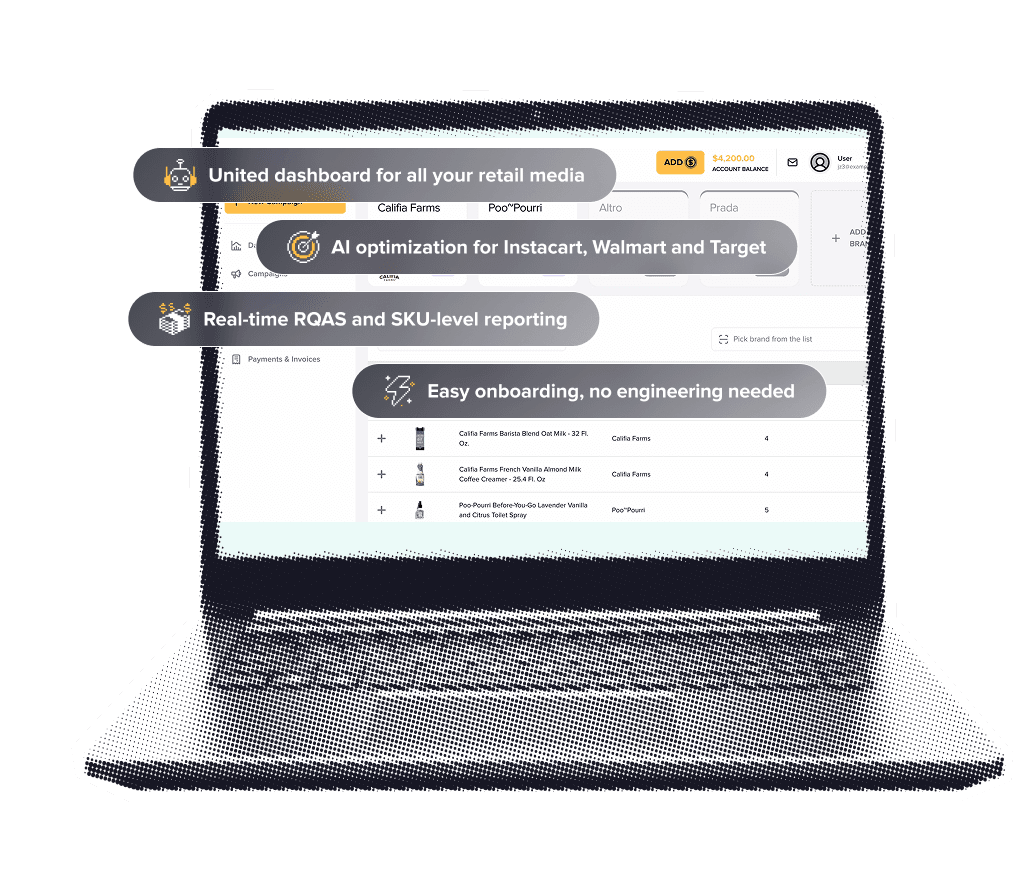
RMIQ accelerates Dynamic Product Ads (DPAs) at enterprise scale by unifying catalog, audience, and performance workflows across key retail media networks—Walmart, Instacart, Amazon, Sprouts, Thrive Market, Target, Uber, and more—so teams can plan, execute, and optimize without hopping dashboards or stitching fragmented datasets. Its multi‑agent AI architecture assigns autonomous agents to core DPA levers—bid adjustments, budget allocation, cross‑network learning, A/B test orchestration, and continuous strategy refinement—allowing campaigns to adapt in real time to SKU‑level signals, pricing changes, and shifting demand. With real‑time bidding, keyword optimization, and adaptive pacing in a single interface, RMIQ streamlines catalog ingestion and eligibility checks, aligns product sets to retailer requirements, and automates creative and variant testing to maximize incremental sales with precision.

Brands leverage RMIQ’s coverage of more than twenty retail media platforms—reaching up to 85% of the U.S. retail audience—to extend DPAs efficiently across marketplaces while maintaining consistent governance, controls, and reporting. The result is measurable performance lift without manual micromanagement: RMIQ reports an average increase of over 50% in ROAS and up to five dollars in new sales for every dollar invested, driven by always‑on optimization that reallocates spend toward high‑velocity SKUs and responsive audiences.

For operators, the unified workflow consolidates planning, activation, dashboards, and reporting, eliminating multiple log‑ins and reconciliation time, while enterprise‑grade scalability supports thousands of SKUs and complex account structures. Onboarding is fast—setup times are reported as short as five minutes—and backed by responsive customer support, enabling teams to operationalize DPAs quickly and focus on strategy rather than manual execution. In short, RMIQ provides a next‑generation foundation for dynamic, cross‑network product advertising, combining AI‑driven automation with user‑friendly management to help B2B marketers capture demand, improve efficiency, and compound returns across retail media, while reducing risk, improving forecast accuracy, and standardizing DPA governance across teams and regions.


Skills and tools for DPAs

Skills needed include data privacy knowledge, legal expertise, and contract drafting. Tools required are compliance management software, data mapping tools, and secure communication platforms. For Dynamic Product Ads, skills in digital marketing, coding (JavaScript, HTML), and data analytics are essential, along with tools like ad platforms (Facebook Ads, Google Ads) and product feed management systems.

Our Current Partners

We are already helping leading retailers and platforms grow their retail media businesses, including:

Partners 2
Partners 1
Partners 4
Partners 6
Partners 5
Partners 4
Partners 3
Partners 2
Partners 1
Partners 3

Drop your email 

and we’ll show you how to double your retail media ROAS – no strings attached

mega
laptop
laptop
star green