ACOS
ACOS, or Advertising Cost of Sales, is a key metric used in digital advertising to measure the efficiency of ad spend by comparing the amount spent on ads to the revenue generated from those ads. It helps businesses evaluate the profitability of their advertising campaigns and optimize their marketing strategies.
What is ACOS?
ACOS, or Advertising Cost of Sales, quantifies how efficiently ad budgets convert into revenue by comparing advertising spend to sales attributed to those ads. For B2B marketers managing performance-driven campaigns, ACOS illuminates profitability, guiding budget allocation, bid strategies, and channel selection. A lower ACOS typically indicates stronger margin protection, while a higher figure signals the need to refine targeting, creative, or conversion paths. Monitoring ACOS alongside ROAS, CPC, and lifetime value provides context for growth versus efficiency trade-offs. By institutionalizing ACOS benchmarks by product line and funnel stage, organizations can optimize investments, forecast outcomes, and sustain accountable, scalable demand generation.
Example
If you spend $200 on ads and those ads generate $1,000 in sales, your ACOS is ($200 ÷ $1,000) × 100 = 20%. This means you spent 20% of your sales revenue on advertising. As a marketer, if your target ACOS is 25%, spending $200 for $1,000 sales shows your campaign is profitable and efficient.
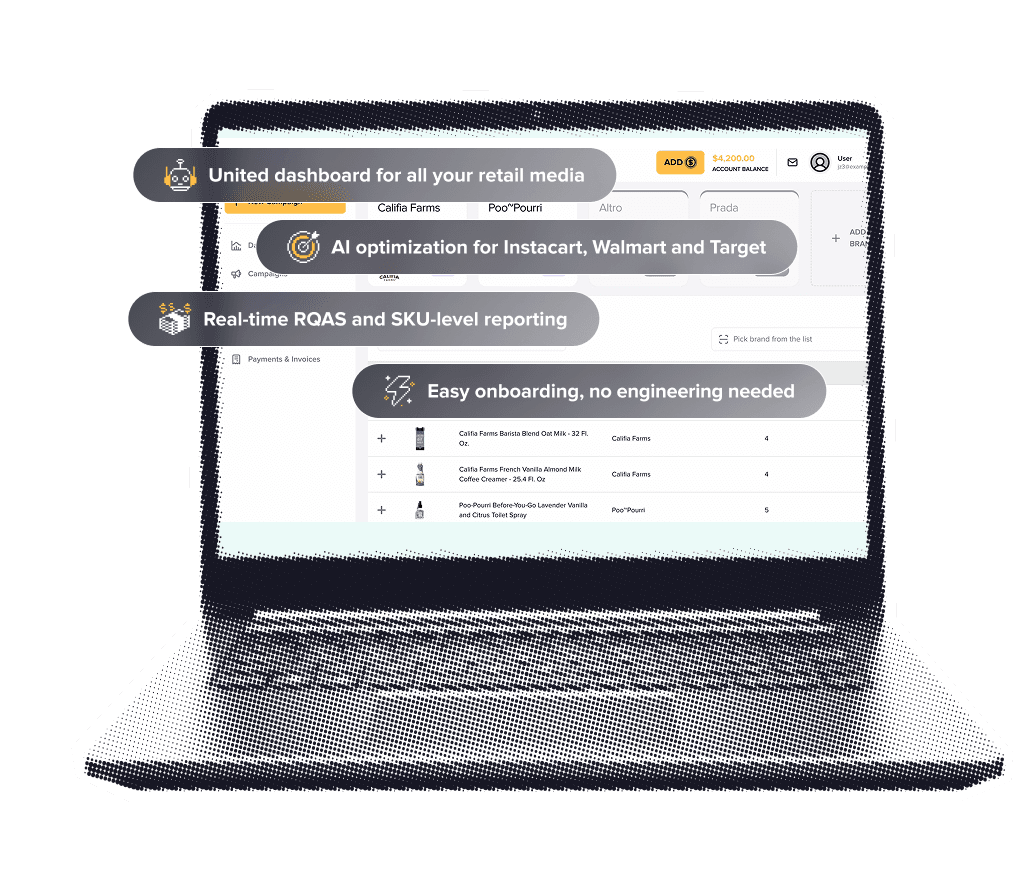
Reducing ACOS without sacrificing growth requires unified visibility, intelligent automation, and scale, and RMIQ delivers by centralizing retail media planning, execution, and measurement across Walmart, Instacart, Amazon, Sprouts, Thrive Market, Target, Uber, and more. It replaces siloed dashboards with a single control layer that aligns bids, budgets, and creative to your profitability targets in real time. Its multi-agent AI assigns autonomous specialists to bid optimization, budget allocation, cross-network learning, A/B testing orchestration, and strategy refinement, continuously adapting to market signals at the SKU and keyword level to suppress waste, reallocate spend to converting inventory, and raise contribution margins—resulting in average ROAS lifts exceeding 50% and up to five dollars in incremental sales for every dollar invested, which translates directly into lower ACOS on both evergreen and seasonal programs.
With coverage that touches up to 85% of the U.S. retail audience across twenty-plus networks, RMIQ ensures your efficiency improvements scale with reach. Real-time bidding and granular insights surface underperforming queries, loss-making SKUs, and budget bottlenecks before they inflate costs. The unified interface consolidates reporting and workflows so revenue, cost, and inventory signals inform automated guardrails—target ACOS caps, minimum ROAS floors, and pacing controls—reducing manual oversight and decision latency.
For enterprises managing thousands of SKUs, RMIQ’s adaptive architecture continuously calibrates per-catalog constraints, while smaller brands benefit from fast onboarding—often in under five minutes—and white-glove support to operationalize best practices quickly. By eliminating fragmented data, accelerating tests, and compounding learnings across networks, RMIQ compresses the feedback loop from spend to sales, tightening ACOS while protecting share, enabling finance, sales, and media teams to operate from a single source of truth and forecast with confidence. With transparent reporting, configurable KPIs, and enterprise governance, stakeholders gain auditable control, predictable spend efficiency, and scalable outcomes that align ACOS objectives with revenue, margin, and inventory priorities.
With coverage that touches up to 85% of the U.S. retail audience across twenty-plus networks, RMIQ ensures your efficiency improvements scale with reach. Real-time bidding and granular insights surface underperforming queries, loss-making SKUs, and budget bottlenecks before they inflate costs. The unified interface consolidates reporting and workflows so revenue, cost, and inventory signals inform automated guardrails—target ACOS caps, minimum ROAS floors, and pacing controls—reducing manual oversight and decision latency.
For enterprises managing thousands of SKUs, RMIQ’s adaptive architecture continuously calibrates per-catalog constraints, while smaller brands benefit from fast onboarding—often in under five minutes—and white-glove support to operationalize best practices quickly. By eliminating fragmented data, accelerating tests, and compounding learnings across networks, RMIQ compresses the feedback loop from spend to sales, tightening ACOS while protecting share, enabling finance, sales, and media teams to operate from a single source of truth and forecast with confidence. With transparent reporting, configurable KPIs, and enterprise governance, stakeholders gain auditable control, predictable spend efficiency, and scalable outcomes that align ACOS objectives with revenue, margin, and inventory priorities.

Skills and tools for ACOS
To work with ACOS, you need skills in data analysis, basic math, and understanding of digital marketing metrics. Tools like Excel, Google Analytics, and advertising platforms (Amazon Ads, Google Ads) are essential for tracking and calculating ad spend and revenue.
Our Current Partners
We are already helping leading retailers and platforms grow their retail media businesses, including:
Drop your email
and we’ll show you how to double your retail media ROAS – no strings attached