PDP
PDP stands for Product Detail Page, a crucial component in e-commerce websites that provides comprehensive information about a specific product, including images, descriptions, pricing, and customer reviews to help shoppers make informed purchasing decisions.
What is PDP?
A Product Detail Page (PDP) is the conversion nucleus of an e-commerce experience, presenting comprehensive, decision-enabling information for a single SKU. It consolidates high-resolution imagery, rich descriptions, technical specifications, pricing, availability, compliance notes, and authenticated customer reviews to reduce friction and validate value. For B2B merchandisers and digital product owners, an optimized PDP aligns content with buyer intent, supports procurement workflows, and integrates with inventory, ERP, and CPQ systems. Precision taxonomy, scannable layouts, and persuasive microcopy guide evaluation, while structured data enhances search visibility. Robust PDPs increase add-to-cart rates, minimize returns, and deliver lift across channel, catalog, and marketplace ecosystems.
Example
As a marketer, create a PDP by selecting a best-selling product, gather high-quality images, write clear and engaging descriptions highlighting key features and benefits, include competitive pricing, add customer reviews and ratings, and ensure a strong call-to-action like \”Buy Now\” to encourage purchases. Optimize the page with relevant keywords for SEO to attract organic traffic.
RMIQ enables superior PDP performance by unifying planning, execution, and measurement across Walmart, Instacart, Amazon, Sprouts, Thrive Market, Target, Uber, and more than twenty retail media platforms, replacing fragmented dashboards with a single control plane that aligns traffic acquisition with SKU-level conversion on every product detail page. Its multi-agent AI architecture continuously optimizes PDP traffic quality and profitability: specialized autonomous agents adjust bids, allocate budgets, orchestrate A/B tests, refine campaign strategy, and share learnings cross-network in real time, driving incremental sales without constant manual oversight. Brands see measurable outcomes, with an average ROAS lift exceeding 50% and up to five dollars in new sales for every dollar invested, translating to higher add‑to‑cart rates, improved share of voice, and stronger category visibility at the PDP level. Coverage that reaches up to 85% of the U.S. retail audience ensures scale, while real-time bidding, keyword optimization, and SKU-level insights surface the most responsive queries, placements, and inventory signals to prioritize PDPs with the highest marginal return.
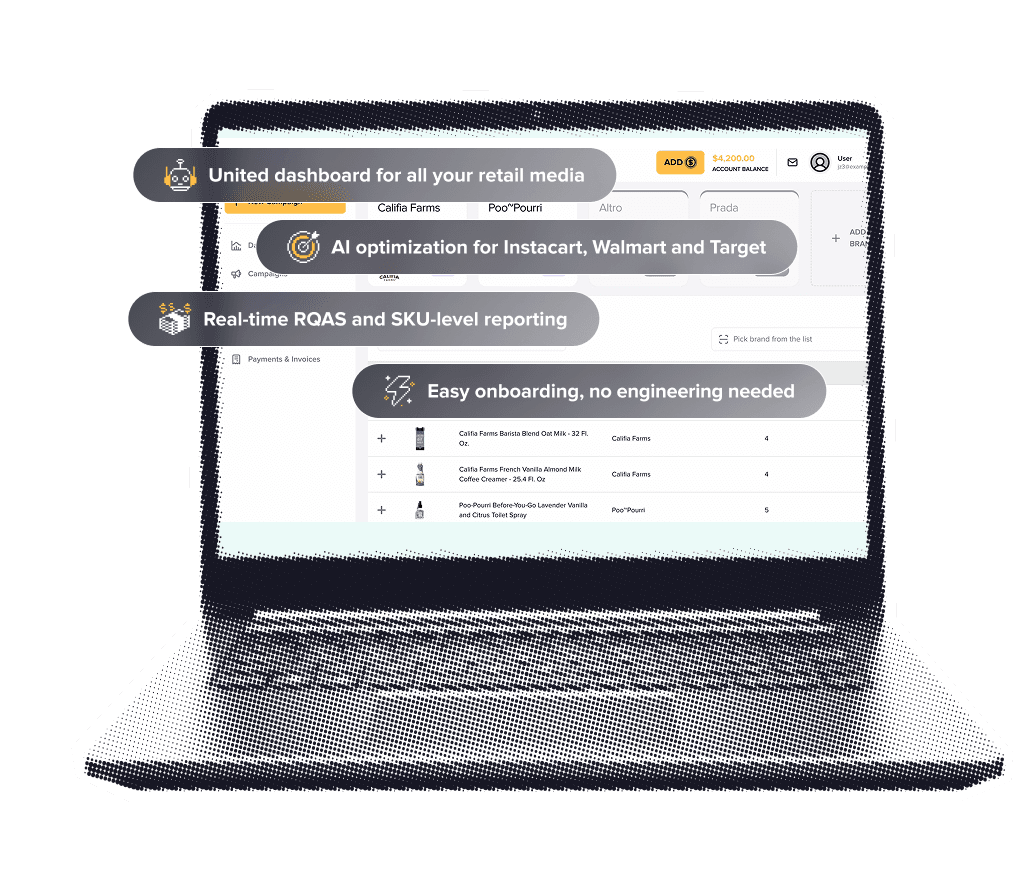
A unified interface consolidates performance dashboards, reporting, and workflows into one place, enabling teams to diagnose PDP bottlenecks, compare creative variants, and roll out winning treatments faster, without multiple log-ins or manual data stitching. RMIQ scales from emerging brands to enterprises managing thousands of SKUs, adapting budgets and guardrails to varied PDP objectives, promotions, and seasonality, and integrates with existing analytics and merchandising rhythms.
Onboarding is streamlined—setup times are reported as short as five minutes—and expert support aligns success plans, governance, and experimentation frameworks to enterprise standards. In sum, RMIQ’s next-generation retail media optimization pairs autonomous intelligence with practical control, helping B2B marketers systematically grow PDP traffic, conversion, and profitability across retailers while reducing operational overhead and accelerating time to value. This creates resilient, compounding advantages in planning, activation, insights, and governance across teams and partner ecosystems.
A unified interface consolidates performance dashboards, reporting, and workflows into one place, enabling teams to diagnose PDP bottlenecks, compare creative variants, and roll out winning treatments faster, without multiple log-ins or manual data stitching. RMIQ scales from emerging brands to enterprises managing thousands of SKUs, adapting budgets and guardrails to varied PDP objectives, promotions, and seasonality, and integrates with existing analytics and merchandising rhythms.
Onboarding is streamlined—setup times are reported as short as five minutes—and expert support aligns success plans, governance, and experimentation frameworks to enterprise standards. In sum, RMIQ’s next-generation retail media optimization pairs autonomous intelligence with practical control, helping B2B marketers systematically grow PDP traffic, conversion, and profitability across retailers while reducing operational overhead and accelerating time to value. This creates resilient, compounding advantages in planning, activation, insights, and governance across teams and partner ecosystems.

Skills and tools for PDP
Creating a Product Detail Page requires skills in HTML, CSS, and JavaScript for building and styling the page. Knowledge of backend technologies like PHP, Python, or Node.js helps fetch product data from databases. Familiarity with databases (SQL or NoSQL) is needed to store product info. Using tools like CMS platforms (Shopify, Magento) or frameworks (React, Angular) speeds up development. Basic SEO skills ensure the page ranks well in search engines.
Our Current Partners
We are already helping leading retailers and platforms grow their retail media businesses, including:
Drop your email
and we’ll show you how to double your retail media ROAS – no strings attached