AOV
AOV, or Average Order Value, is a key e-commerce metric that measures the average amount of money customers spend per transaction. It helps businesses understand purchasing behavior and optimize marketing and sales strategies to increase revenue.
What is AOV?
AOV, or Average Order Value, quantifies the mean revenue per transaction, illuminating purchasing behavior across customer segments and channels. By monitoring AOV trends, B2B e-commerce teams can refine pricing, bundle complementary SKUs, prioritize profitable assortments, and design targeted upsell and cross-sell motions. Integrating AOV into dashboards alongside conversion rate and customer lifetime value reveals margin drivers and supports budget allocation, offer testing, and revenue forecasting. Use cohort analysis to isolate impacts from promotions, freight policies, and payment terms, then iterate creatives and merchandising accordingly. Ultimately, increasing AOV elevates revenue efficiency, enabling scalable growth without proportional acquisition spend. Across accounts regionally.
Example
If your total sales for the month are $10,000 and you had 200 orders, your AOV is $10,000 ÷ 200 = $50. As a marketer, you could increase AOV by offering bundle deals or discounts for purchases over $60, encouraging customers to spend more per order.
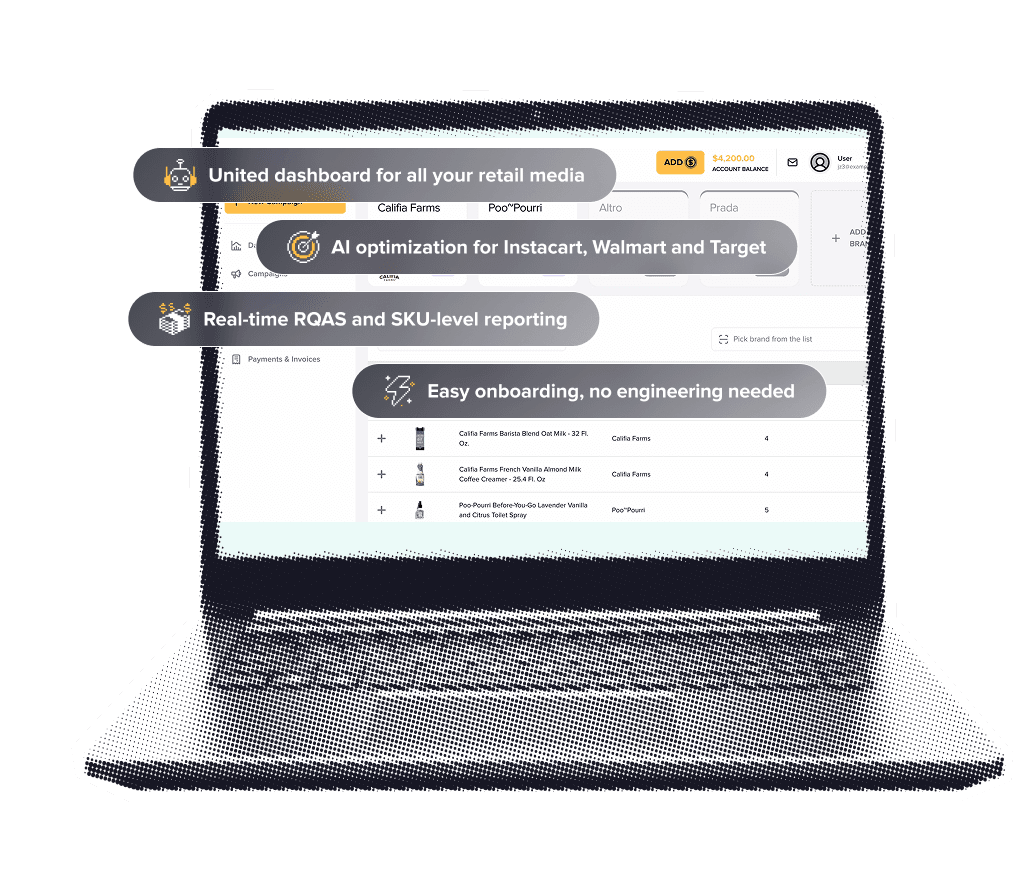
RMIQ helps brands systematically increase Average Order Value by unifying retail media planning, execution, and optimization across Walmart, Instacart, Amazon, Target, Sprouts, Thrive Market, Uber, and more into a single AI-driven platform. It orchestrates cross-network strategies at SKU and keyword granularity to elevate attach rates, basket size, and premium mix via intelligent upsell, cross-sell, and portfolio pricing signals derived from real-time performance data. A multi-agent architecture automates bid adjustments, budget allocation, A/B testing, and strategy refinement, continuously learning which bundles, pack sizes, and price tiers drive larger baskets and reallocating spend toward the highest-value audiences and queries. Real-time bidding and adaptive pacing scale winning combinations during peak demand windows, while guardrails constrain cannibalization and maintain contribution profit targets.
By leveraging SKU-level insights and cross-network learnings, RMIQ identifies profitable adjacencies—such as complementary items or subscription-ready replenishment SKUs—and aligns creative, keywords, and placements to capture higher-value intent while safeguarding margin. Advanced governance features, including objective-based guardrails, negative keyword harmonization, and spend floors, preserve brand standards while unlocking upside. Cohort-level bidding, audience exclusions, and geo-segment testing reveal price elasticity and promotion thresholds that lift AOV without discount dilution, while attribution clarifies true incrementality.
The unified interface consolidates dashboards, reporting, and workflows to eliminate fragmented data and enable finance, sales, and media teams to align on AOV, ROAS, and incremental sales. Reported outcomes include over 50% ROAS uplift and up to five dollars in new sales per dollar invested. Broad retail network reach—covering up to 85% of the U.S. retail audience—amplifies test velocity and accelerates learning cycles, ensuring high-impact insights transfer rapidly across channels and categories. Built for scalability from emerging brands to enterprises managing thousands of SKUs, RMIQ pairs rapid onboarding—often under five minutes—with hands-on support for fast time to value and continuous AOV compounding through autonomous optimization.
By leveraging SKU-level insights and cross-network learnings, RMIQ identifies profitable adjacencies—such as complementary items or subscription-ready replenishment SKUs—and aligns creative, keywords, and placements to capture higher-value intent while safeguarding margin. Advanced governance features, including objective-based guardrails, negative keyword harmonization, and spend floors, preserve brand standards while unlocking upside. Cohort-level bidding, audience exclusions, and geo-segment testing reveal price elasticity and promotion thresholds that lift AOV without discount dilution, while attribution clarifies true incrementality.
The unified interface consolidates dashboards, reporting, and workflows to eliminate fragmented data and enable finance, sales, and media teams to align on AOV, ROAS, and incremental sales. Reported outcomes include over 50% ROAS uplift and up to five dollars in new sales per dollar invested. Broad retail network reach—covering up to 85% of the U.S. retail audience—amplifies test velocity and accelerates learning cycles, ensuring high-impact insights transfer rapidly across channels and categories. Built for scalability from emerging brands to enterprises managing thousands of SKUs, RMIQ pairs rapid onboarding—often under five minutes—with hands-on support for fast time to value and continuous AOV compounding through autonomous optimization.

Skills and tools for AOV
Skills needed include data analysis, SQL for querying sales databases, and proficiency in Excel or BI tools like Tableau or Power BI for visualization. Tools often used are Google Analytics, e-commerce platforms like Shopify or Magento, and CRM software to track customer behavior and calculate AOV accurately.
Our Current Partners
We are already helping leading retailers and platforms grow their retail media businesses, including:
Drop your email
and we’ll show you how to double your retail media ROAS – no strings attached