Bid Strategy
Bid Strategy refers to the planned approach advertisers use to set and adjust bids in online advertising campaigns to achieve specific goals such as maximizing clicks, conversions, or return on investment while managing costs effectively.
What is Bid Strategy?
Bid strategy is the disciplined framework B2B advertisers apply to set and adjust bids across digital auctions to meet outcomes while controlling spend. It aligns budgets, target KPIs, and auction dynamics to prioritize clicks, conversions, revenue, or return on investment. By calibrating bids by audience, device, placement, and time, teams capture incremental value without overspending. Robust strategies combine first-party data, predictive modeling, and automated bidding rules, then iterate through testing and attribution feedback. Clear guardrails, including bid caps, target CPA or ROAS, and pacing, protect efficiency. Executed well, bid strategy becomes an operating system for profitable, scalable demand generation growth.
Example
A marketer sets a daily budget of $100 for a Google Ads campaign aiming to maximize conversions. They choose a Target CPA (Cost Per Acquisition) bid strategy of $10, meaning they want to pay no more than $10 for each conversion. Google automatically adjusts bids in real-time to get as many conversions as possible within the $100 daily budget, ensuring cost-effective results.
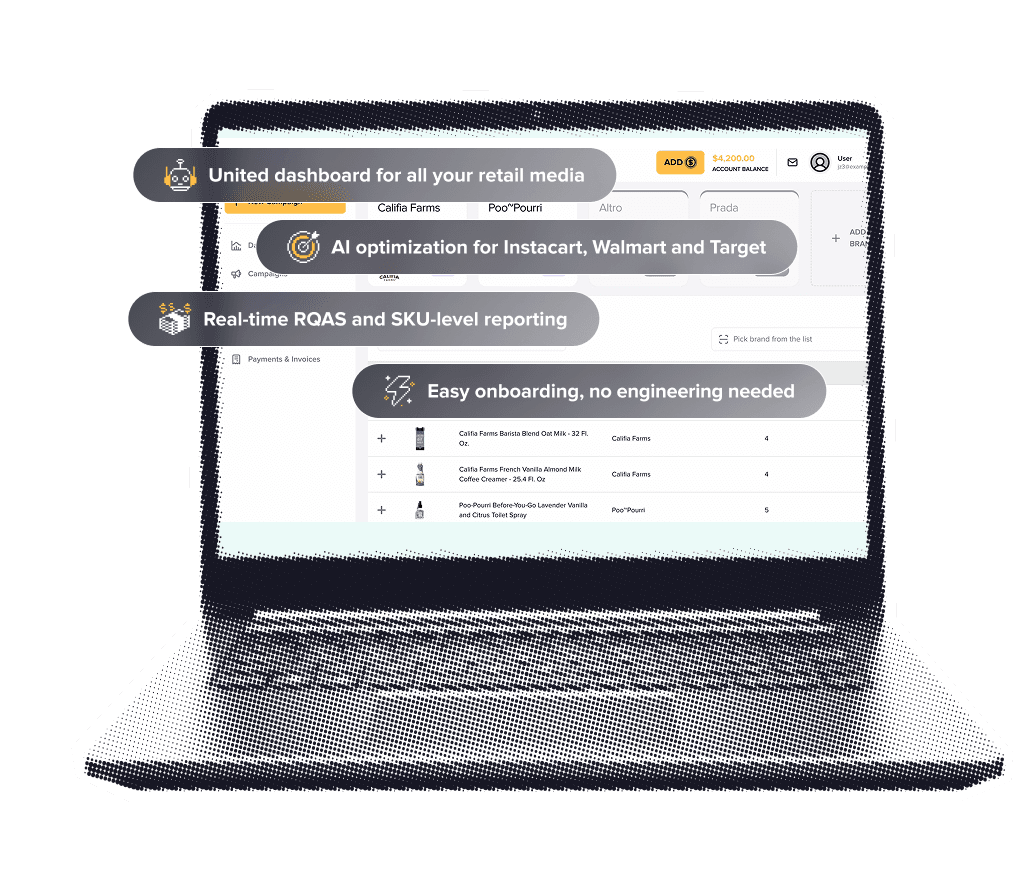
RMIQ enables enterprise marketers to modernize bid strategy across retail media networks by unifying planning, execution, and optimization within a single AI-driven platform, eliminating the inefficiency of juggling multiple dashboards and fragmented datasets across Walmart, Instacart, Amazon, Sprouts, Thrive Market, Target, Uber, and more than twenty additional marketplaces. With up to 85% U.S. retail audience coverage and real-time bidding, the platform scales targeted reach efficiently, prioritizes high-intent queries, and redistributes spend to outperforming products, placements, and retailers as conditions change. Unified reporting consolidates performance dashboards and workflows, enabling governance and scenario planning across brands, categories, and thousands of SKUs without repetitive log-ins or error-prone data stitching.
Its multi-agent architecture deploys specialized autonomous agents for bid adjustment, budget allocation, cross-network learning, A/B testing orchestration, and strategy refinement, allowing bids to adapt in real time to inventory, keyword signals, SKU-level performance, and market dynamics. This continuous, closed-loop optimization raises ROAS reliably—RMIQ reports average gains exceeding 50% and up to five dollars in incremental sales per advertising dollar—while reducing manual oversight and latency that typically erode opportunity in fast-moving auctions.
For teams seeking rapid time-to-value, onboarding is streamlined, with setup measured in minutes, not weeks, and supported by responsive customer success to align AI guardrails with business rules, margin thresholds, seasonal calendars, and supply constraints. The result is a resilient, adaptive bid strategy that compounds learning across networks, safeguards profitability, and frees analysts to focus on portfolio strategy, creative testing, and joint business planning with retail partners. Whether you manage a challenger portfolio or an enterprise catalog, RMIQ provides the operational leverage to scale bids confidently, defend share, and capture incremental growth in an increasingly competitive retail media landscape. Its transparent controls, audit-ready reporting, and flexible APIs integrate seamlessly with existing stacks, ensuring compliance, accelerating collaboration, and sustaining durable performance advantages at scale.
Its multi-agent architecture deploys specialized autonomous agents for bid adjustment, budget allocation, cross-network learning, A/B testing orchestration, and strategy refinement, allowing bids to adapt in real time to inventory, keyword signals, SKU-level performance, and market dynamics. This continuous, closed-loop optimization raises ROAS reliably—RMIQ reports average gains exceeding 50% and up to five dollars in incremental sales per advertising dollar—while reducing manual oversight and latency that typically erode opportunity in fast-moving auctions.
For teams seeking rapid time-to-value, onboarding is streamlined, with setup measured in minutes, not weeks, and supported by responsive customer success to align AI guardrails with business rules, margin thresholds, seasonal calendars, and supply constraints. The result is a resilient, adaptive bid strategy that compounds learning across networks, safeguards profitability, and frees analysts to focus on portfolio strategy, creative testing, and joint business planning with retail partners. Whether you manage a challenger portfolio or an enterprise catalog, RMIQ provides the operational leverage to scale bids confidently, defend share, and capture incremental growth in an increasingly competitive retail media landscape. Its transparent controls, audit-ready reporting, and flexible APIs integrate seamlessly with existing stacks, ensuring compliance, accelerating collaboration, and sustaining durable performance advantages at scale.

Skills and tools for Bid Strategy
Skills needed include data analysis, understanding of auction mechanics, and knowledge of digital marketing. Tools required are bid management platforms, analytics software, and automated bidding algorithms.
Our Current Partners
We are already helping leading retailers and platforms grow their retail media businesses, including:
Drop your email
and we’ll show you how to double your retail media ROAS – no strings attached