Category Performance

Category Performance refers to the measurement and analysis of how different product or service categories are performing within a business. It involves evaluating sales, revenue, market share, and other key metrics to identify trends, strengths, and areas for improvement. This insight helps businesses make informed decisions to optimize their product mix and drive growth.

What is Category Performance?

Category performance is the disciplined measurement and analysis of how distinct product or service categories contribute to commercial outcomes. By tracking sales, revenue, margin, velocity, market share, and adjacent indicators, leaders uncover trends, strengths, and gaps across the portfolio. These insights inform assortment rationalization, pricing and promotion strategy, inventory allocation, and channel prioritization, ensuring resources align with demand. Executives leverage dashboards and cohort analyses to benchmark categories, diagnose underperformance, and scale proven plays. Applied consistently, category performance management guides investment, sharpens product-market fit, and drives sustainable growth through a more optimized product mix, clearer accountability, and faster, evidence-based decision-making overall.
currency

Example

As a marketer, you analyze sales data for your product categories, like electronics, clothing, and home goods. You notice electronics have high sales but low profit margins, while clothing has steady sales and higher margins. You decide to run promotions on electronics to boost profits and invest more in clothing marketing to increase market share, optimizing overall category performance.
plus
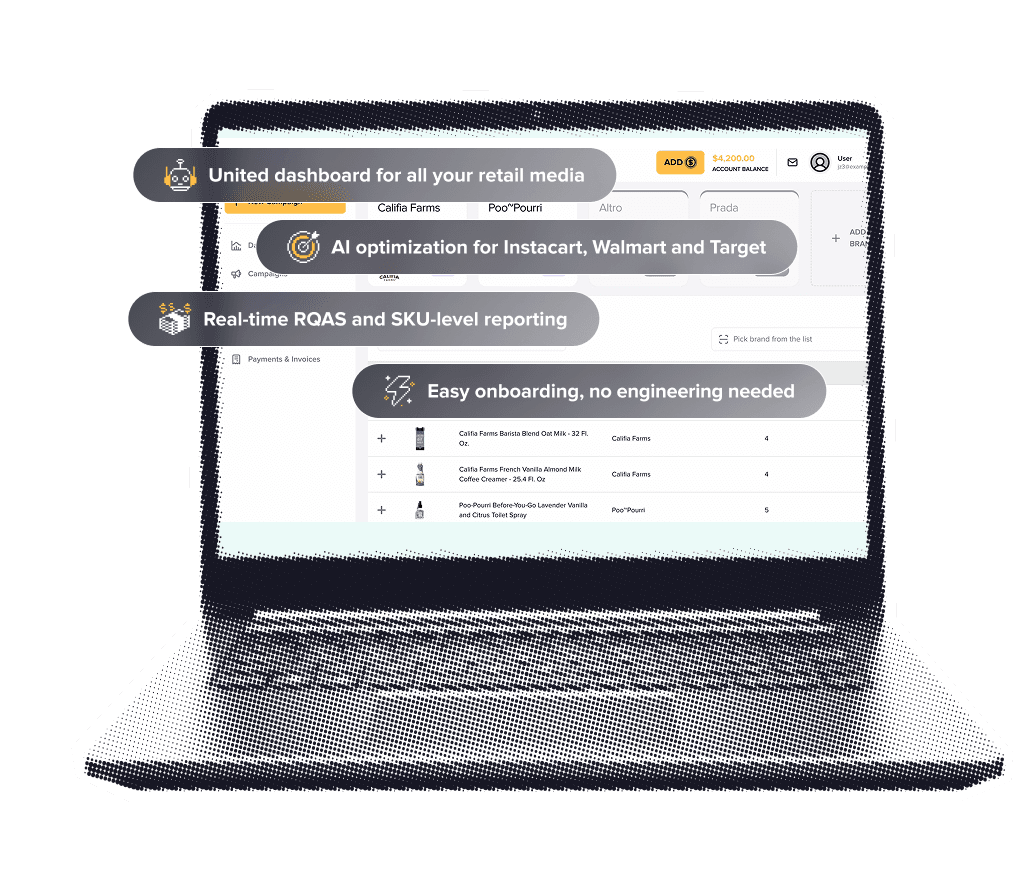
RMIQ elevates category performance by unifying retail media execution across Walmart, Instacart, Amazon, Sprouts, Thrive Market, Target, Uber, and more, replacing fragmented dashboards with one platform that plans, activates, and measures campaigns end to end. Its multi-agent AI continuously optimizes at the category and SKU level, with specialized autonomous agents coordinating bid adjustments, budget allocations, keyword refinement, cross-network learning, and systematic A/B testing to adapt strategy in real time. This intelligent automation reduces manual overhead while maximizing ROAS, with clients reporting average lifts above 50% and up to five dollars in incremental sales for every dollar invested. Coverage that reaches up to 85% of U.S. retail audiences lets brands grow share within priority categories by targeting high-propensity shoppers wherever they browse, while real-time bidding and granular SKU insights ensure budget flows to the most efficient subcategories, terms, and placements.

A single, consolidated interface streamlines reporting and governance for category managers and media teams, eliminating multiple log-ins and data stitching, and enabling consistent taxonomies, pacing controls, and performance benchmarks across retailers. RMIQ scales from emerging brands to enterprises managing thousands of SKUs, preserving performance at portfolio breadth and depth, and supports rapid onboarding with setup measured in minutes.

Teams can codify category strategies as AI-guardrails—defining profit thresholds, inventory constraints, and promotional calendars—so autonomous agents honor business rules while still exploiting marketplace opportunities. With adaptive learning that transfers insights cross-network, the platform accelerates best-practice propagation, preventing siloed optimization and ensuring sustainable, defensible category gains. The result is a next-generation retail media operating system that aligns media investment to category outcomes—growth, margin, and share—delivering agile execution, transparent measurement, and scalable control in one place. Executive dashboards surface variance analysis, cohort trends, and forecasted demand, empowering stakeholders to recalibrate mix, reallocate budgets, and negotiate retailer terms with confidence based on unified, real-time evidence daily.


Skills and tools for Category Performance

Skills needed include data analysis, critical thinking, and familiarity with business metrics. Tools commonly used are Excel, SQL, data visualization software like Tableau or Power BI, and sometimes analytics platforms like Google Analytics or specialized category management software.

Our Current Partners

We are already helping leading retailers and platforms grow their retail media businesses, including:

Partners 2
Partners 1
Partners 4
Partners 6
Partners 5
Partners 4
Partners 3
Partners 2
Partners 1
Partners 3

Drop your email 

and we’ll show you how to double your retail media ROAS – no strings attached

mega
laptop
laptop
star green