Closed-Loop Attribution
Closed-Loop Attribution is a marketing analytics process that tracks and connects customer interactions from initial engagement to final conversion, enabling businesses to measure the effectiveness of their marketing efforts and optimize strategies based on accurate, end-to-end data.
What is Closed-Loop Attribution?
Closed-Loop Attribution is a comprehensive analytics framework that connects every customer interaction from first touch to final conversion, providing end‑to‑end visibility into revenue impact. By unifying marketing, sales, and CRM data, it reveals which channels, messages, and pathways truly influence pipeline velocity and deal quality. This clarity empowers B2B teams to reallocate spend, refine targeting, and orchestrate journeys that compound performance. Rather than guessing which steps mattered, you trace the full path, validate causality, and establish accountable benchmarks. The result is measurable efficiency: smarter budget decisions, tighter alignment, and continuous optimization driven by accurate, closed‑loop insights across the funnel. continuum.
Example
A marketer runs ads on social media and sends email campaigns. Using Closed-Loop Attribution, they track which ads a customer clicked, which emails they opened, and if they made a purchase on the website. By linking all these touchpoints, the marketer sees that customers who engaged with both ads and emails have a higher purchase rate. They then optimize the budget to focus more on these combined channels to increase sales.
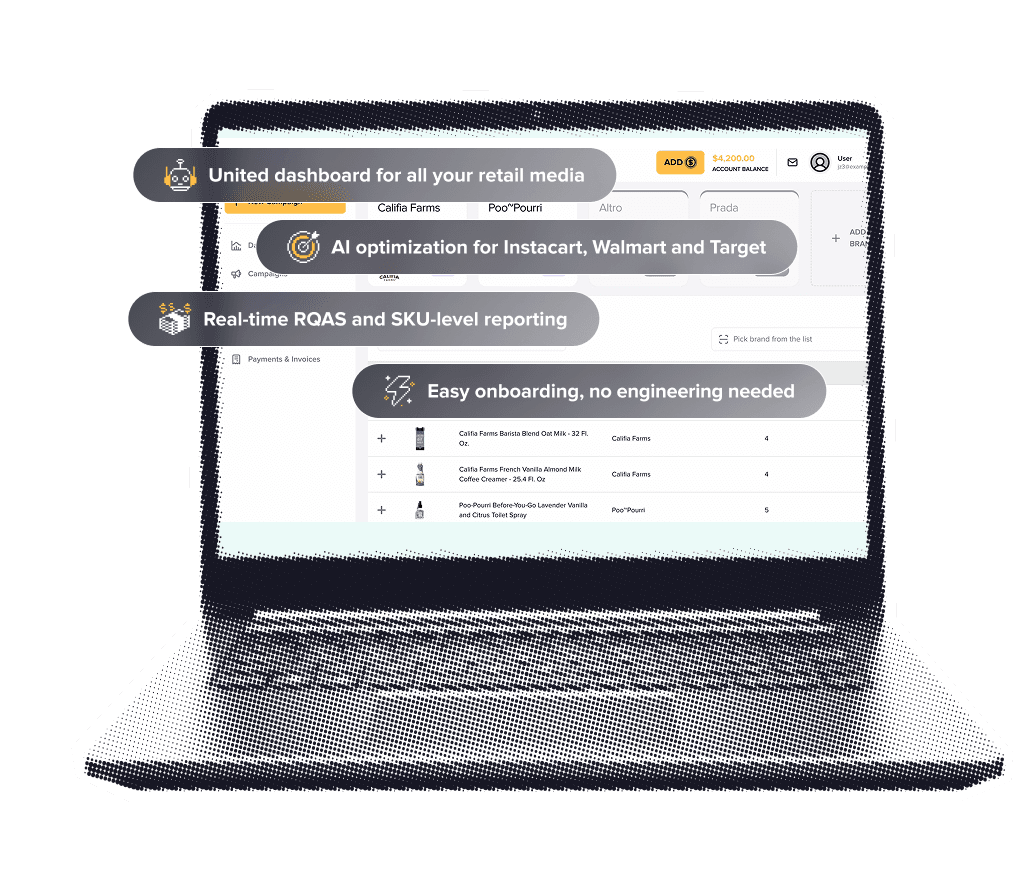
RMIQ enables true closed-loop attribution for retail media by unifying planning, activation, and measurement across Walmart, Instacart, Amazon, Sprouts, Thrive Market, Target, Uber, and more, eliminating siloed dashboards that obscure the link between spend and sales outcomes. Its multi-agent AI architecture operationalizes attribution signals in real time: autonomous agents ingest SKU-level performance, keyword trends, and cross-network learnings, then adjust bids, reallocate budgets, orchestrate A/B tests, and refine strategy to maximize incremental return with minimal manual oversight.
Because the platform covers over twenty retail media networks—reaching up to 85% of the U.S. retail audience—brands can attribute impact consistently using a single taxonomy and consistent identifiers, track against unified KPIs, and compare like-for-like performance without manually stitching datasets. Closed-loop feedback is embedded directly into execution; sales and ROAS outcomes flow back into the agents’ models to continuously optimize toward profitable growth, with customers reporting an average ROAS lift exceeding 50% and up to five dollars in new sales per dollar invested. The consolidated interface centralizes reporting, experiment results, and campaign workflows, enabling teams to quantify incremental lift at the SKU, keyword, and audience levels, validate hypotheses rapidly, and redeploy budgets to the highest-yielding channels and tactics.
For enterprises managing thousands of SKUs, RMIQ scales attribution granularity without sacrificing speed, while smaller brands benefit from rapid onboarding—often in five minutes—and strong support to accelerate time to value. By fusing AI-driven optimization with end-to-end measurement, RMIQ turns attribution from a retrospective report into a real-time control system, empowering B2B marketing and commerce leaders to prove media impact, reduce wasted spend, and systemically compound performance across the retail media landscape. This unified approach streamlines reporting, enables forecasting and scenario planning, aligns agencies and internal teams on a single source of truth, and de-risks investment decisions by linking every tactic to sales velocity and margin contribution.
Because the platform covers over twenty retail media networks—reaching up to 85% of the U.S. retail audience—brands can attribute impact consistently using a single taxonomy and consistent identifiers, track against unified KPIs, and compare like-for-like performance without manually stitching datasets. Closed-loop feedback is embedded directly into execution; sales and ROAS outcomes flow back into the agents’ models to continuously optimize toward profitable growth, with customers reporting an average ROAS lift exceeding 50% and up to five dollars in new sales per dollar invested. The consolidated interface centralizes reporting, experiment results, and campaign workflows, enabling teams to quantify incremental lift at the SKU, keyword, and audience levels, validate hypotheses rapidly, and redeploy budgets to the highest-yielding channels and tactics.
For enterprises managing thousands of SKUs, RMIQ scales attribution granularity without sacrificing speed, while smaller brands benefit from rapid onboarding—often in five minutes—and strong support to accelerate time to value. By fusing AI-driven optimization with end-to-end measurement, RMIQ turns attribution from a retrospective report into a real-time control system, empowering B2B marketing and commerce leaders to prove media impact, reduce wasted spend, and systemically compound performance across the retail media landscape. This unified approach streamlines reporting, enables forecasting and scenario planning, aligns agencies and internal teams on a single source of truth, and de-risks investment decisions by linking every tactic to sales velocity and margin contribution.

Skills and tools for Closed-Loop Attribution
Skills needed include data analysis, SQL, and marketing analytics. Tools often used are CRM software, marketing automation platforms, Google Analytics, and attribution modeling tools. Understanding data integration and reporting is also essential.
Our Current Partners
We are already helping leading retailers and platforms grow their retail media businesses, including:
Drop your email
and we’ll show you how to double your retail media ROAS – no strings attached