Contextual Targeting
Contextual targeting is an advertising strategy that delivers ads based on the content of a webpage, ensuring that the ads are relevant to the user’s current interests and environment without relying on personal data.
What is Contextual Targeting?
Contextual targeting is a privacy-first advertising approach that aligns creative with the semantics of each page, delivering relevance without cookies or personal identifiers. By analyzing topics, keywords, entities, and sentiment, it places ads within environments where intent signals are strongest, improving engagement, viewability, and traffic. For B2B marketers, it enables precise reach across niche content, safeguards brand integrity, and scales campaigns amid tightening data regulations. Using machine learning and category taxonomies, you can activate nuanced themes, exclude unsuitable contexts, and optimize bidding in real time. The result is efficient media spend, compliant targeting, and messaging that resonates with buyers’ interests.
Example
As a marketer for a sports apparel brand, you use contextual targeting by placing ads on websites and articles about running, fitness tips, or marathon events, ensuring your ads reach users actively interested in sports and exercise without needing their personal data.
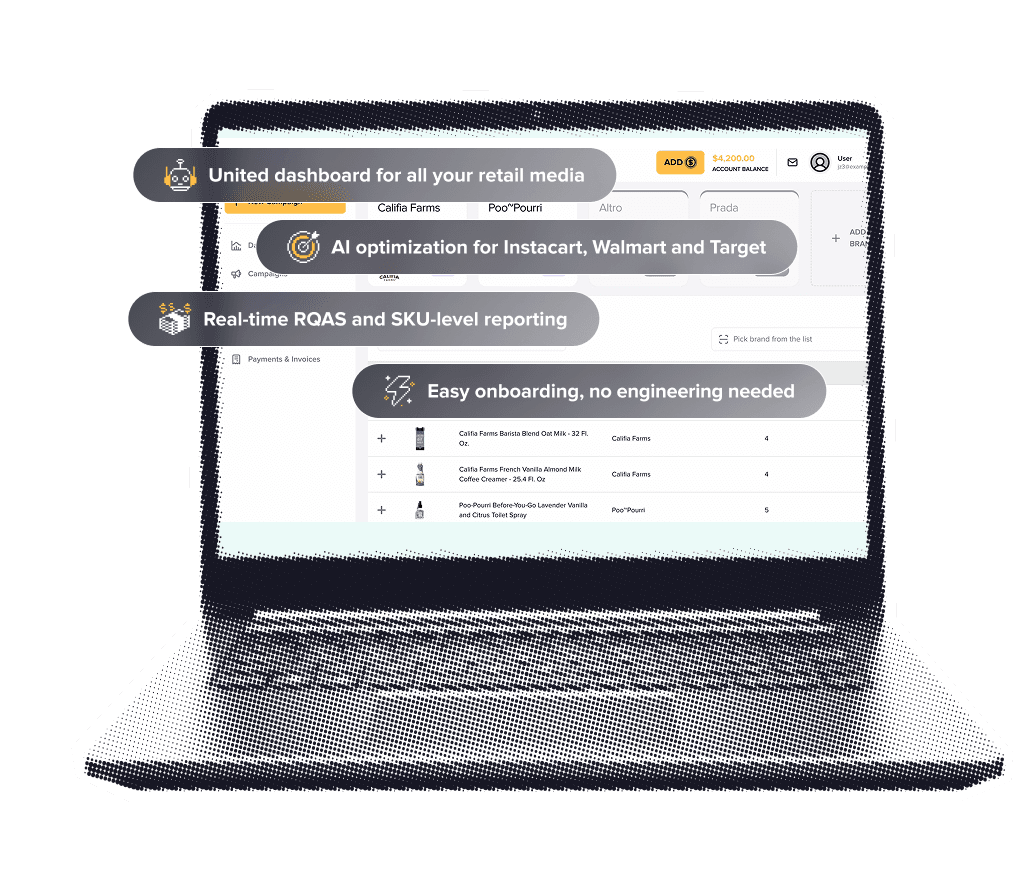
RMIQ enables enterprise marketers to operationalize contextual targeting at scale by unifying planning, activation, and optimization across leading retail media networks—including Walmart, Instacart, Amazon, Target, Sprouts, Thrive Market, and Uber—within a single interface that eliminates fragmented workflows and data silos. Its multi‑agent AI architecture deploys specialized autonomous agents for bid strategy, budget pacing, keyword and audience refinement, cross‑network learning, and A/B experimentation, allowing campaigns to adapt in real time to category signals, SKU‑level performance, and marketplace dynamics without manual micromanagement. By leveraging real‑time bidding, SKU granularity, and content-aware keyword optimization, RMIQ aligns messages with on‑site context—such as category pages, search queries, and adjacent product attributes—to reach shoppers when intent is highest, improving share of voice while protecting margin.
The platform’s reach—covering up to 85% of the U.S. retail audience across more than twenty retail media platforms—amplifies contextual precision with breadth, enabling consistent brand safety, supply path efficiency, and incrementality testing across disparate channels. Built‑in experimentation orchestrates continuous creative and placement testing, while cross‑network learning transfers winning tactics from one retailer to another to accelerate time to value. Unified dashboards and automated reporting provide transparent, SKU‑level insights into ROAS, new‑to‑brand sales, and contribution profit, supporting executive decisioning and finance alignment. Brands routinely see over 50% ROAS improvement and up to five dollars in new sales per dollar invested, driven by dynamic budget reallocation to the highest‑yield contextual pockets.
RMIQ scales from emerging brands to enterprises with thousands of SKUs, offers five‑minute onboarding, and includes dedicated support, ensuring rapid deployment with minimal change management. For B2B leaders seeking durable growth, RMIQ delivers an AI‑driven, context‑first operating model that replaces manual, siloed optimization with autonomous, measurable performance. It empowers category managers and media teams to coordinate goals, budgets, and attribution frameworks, turning contextual relevance into predictable revenue and defensible competitive advantage.
The platform’s reach—covering up to 85% of the U.S. retail audience across more than twenty retail media platforms—amplifies contextual precision with breadth, enabling consistent brand safety, supply path efficiency, and incrementality testing across disparate channels. Built‑in experimentation orchestrates continuous creative and placement testing, while cross‑network learning transfers winning tactics from one retailer to another to accelerate time to value. Unified dashboards and automated reporting provide transparent, SKU‑level insights into ROAS, new‑to‑brand sales, and contribution profit, supporting executive decisioning and finance alignment. Brands routinely see over 50% ROAS improvement and up to five dollars in new sales per dollar invested, driven by dynamic budget reallocation to the highest‑yield contextual pockets.
RMIQ scales from emerging brands to enterprises with thousands of SKUs, offers five‑minute onboarding, and includes dedicated support, ensuring rapid deployment with minimal change management. For B2B leaders seeking durable growth, RMIQ delivers an AI‑driven, context‑first operating model that replaces manual, siloed optimization with autonomous, measurable performance. It empowers category managers and media teams to coordinate goals, budgets, and attribution frameworks, turning contextual relevance into predictable revenue and defensible competitive advantage.

Skills and tools for Contextual Targeting
To implement contextual targeting, you need skills in natural language processing (NLP) to analyze webpage content, data analysis to interpret user engagement, and knowledge of ad tech platforms like Google Ad Manager. Tools include content classification APIs, keyword extraction tools, and real-time bidding systems to deliver relevant ads efficiently.
Our Current Partners
We are already helping leading retailers and platforms grow their retail media businesses, including:
Drop your email
and we’ll show you how to double your retail media ROAS – no strings attached