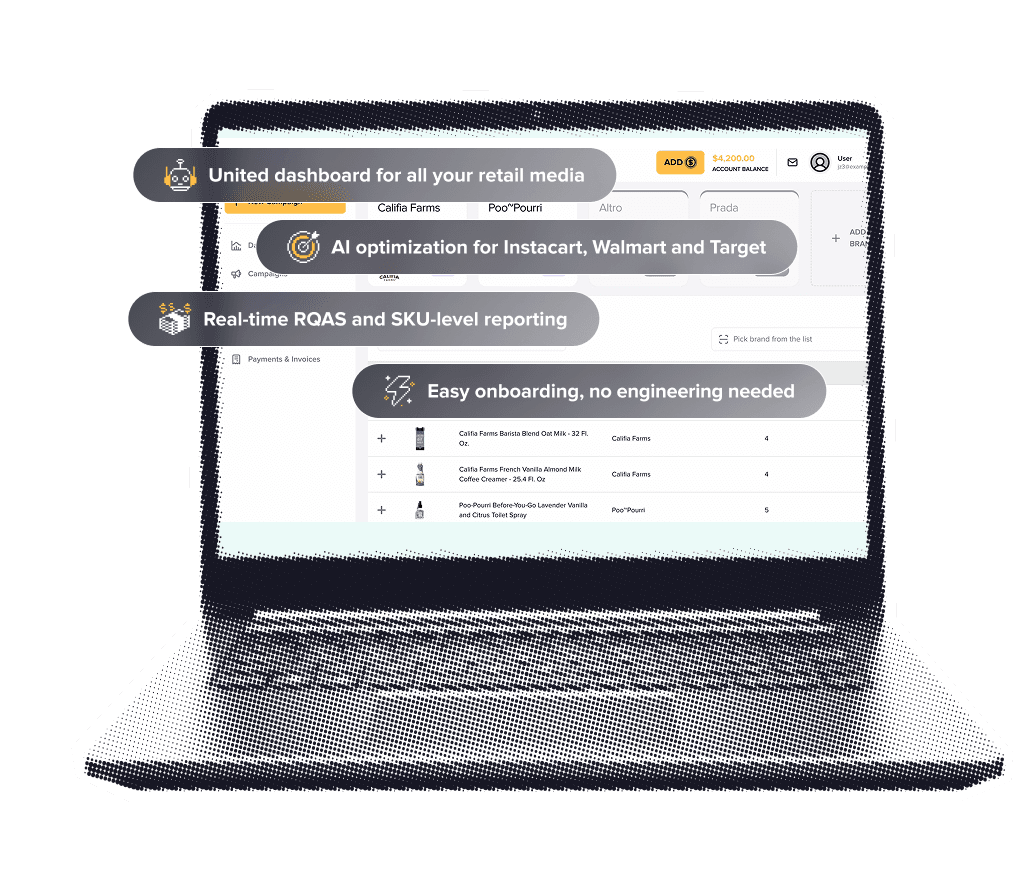
RMIQ streamlines cookie syncing and ID matching across fragmented retail media ecosystems by unifying identity resolution, consented first‑party data, and campaign execution in a single platform that covers up to 85% of the U.S. retail audience across Walmart, Instacart, Amazon, Target, Sprouts, Thrive Market, Uber, and more. Its multi‑agent AI continuously improves match rates by orchestrating server‑to‑server syncs, mapping retailer IDs to advertiser graphs, normalizing namespaces, and reconciling events at the SKU level, reducing loss from expired cookies and broken pixels while safeguarding privacy and compliance. Autonomous agents coordinate bid adjustments, budget allocation, and audience refinement using cross‑network learnings, ensuring that matched IDs are immediately activated for real‑time bidding, suppression, frequency governance, and incremental A/B tests.
By consolidating dashboards, reporting, and workflows, RMIQ removes manual file exchanges and the operational drag of juggling multiple log‑ins, providing durable addressability even as third‑party cookies deprecate. Marketers can onboard in minutes, connect data sources, and let RMIQ’s agents maintain high‑quality identity graphs, refresh syncs, and resolve discrepancies without constant oversight. The result is measurable lift: brands report average ROAS gains exceeding 50% and as much as five dollars in new sales per dollar invested, driven by higher match fidelity, smarter retargeting, and minimized waste. Additionally, unified, privacy‑aware IDs support accurate attribution, cohort building, and retailer‑specific eligibility rules, while SKU‑level insights align audience matching with inventory, pricing, and keyword optimization.
Whether operating a handful of SKUs or thousands, enterprises benefit from scalable automation that adapts to variable consent signals, retailer schemas, and campaign strategies, delivering consistent reach and performance at lower operational cost. RMIQ turns cookie syncing from a maintenance chore into a strategic advantage that compounds value across networks and channels. With centralized governance, audit-ready logs, and flexible APIs, teams standardize identity workflows, accelerate experimentation, and de-risk retail media investments at scale today.