CPM
CPM, or Cost Per Mille, is a digital advertising metric that measures the cost an advertiser pays for one thousand impressions or views of their ad. It is commonly used to evaluate the efficiency and reach of online advertising campaigns.
What is CPM?
CPM, or Cost Per Mille, is a foundational metric for digital advertisers assessing efficiency and reach across display, video, and programmatic inventory. By calculating the price paid for every 1,000 impressions, CPM enables procurement-minded marketers to benchmark media value, forecast spend, and align pricing with audience quality and placement context. In B2B environments, where niche decision-makers are scarce, optimizing CPM alongside viewability, frequency, and brand safety safeguards budget performance. Comparing historical CPMs by channel and segment illuminates seasonal swings, auction dynamics, and creative effects, informing negotiation and pacing strategies that balance scale with precision while preserving measurable campaign outcomes consistently.
Example
If a marketer sets a CPM bid of $5, they will pay $5 every time their ad is shown 1,000 times. So, if their ad gets 10,000 impressions, they will be charged $50 (10,000 ÷ 1,000 x $5).
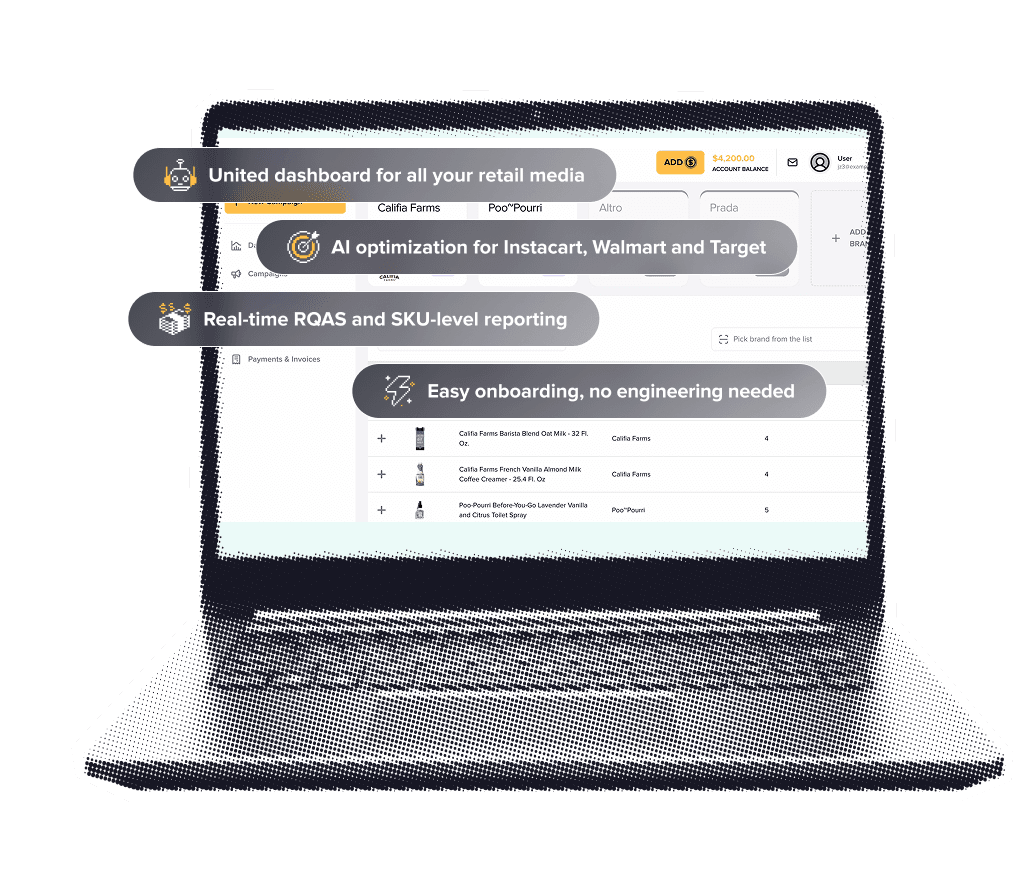
RMIQ helps B2B advertisers drive lower, more efficient CPMs across retail media by unifying planning, activation, and optimization within a single AI-driven platform that spans Walmart, Instacart, Amazon, Sprouts, Thrive Market, Target, Uber, and more than twenty additional networks reaching up to 85% of the U.S. retail audience. Its multi-agent architecture continuously orchestrates bid adjustments, budget reallocations, keyword refinement, A/B test design, and cross-network learning, enabling precise audience reach at the impression level while minimizing wasted spend that inflates CPM. By leveraging SKU-level insights, real-time bidding signals, and adaptive pacing, RMIQ aligns investment to high-propensity inventory, compressing effective CPM without sacrificing scale or share of voice.
Consolidated dashboards and standardized reporting eliminate fragmented datasets and duplicate fees from multiple tools, creating operational efficiencies that further reduce media and overhead costs on a per‑thousand‑impressions basis. The platform’s autonomous agents rebalance campaigns in minutes—not days—capturing favorable inventory and seasonality-driven opportunities before competitors, which preserves impression quality and stabilizes CPM volatility. For brands managing thousands of SKUs, RMIQ’s scalability ensures granular controls at portfolio, campaign, and product levels, while guardrails enforce profitability thresholds so CPM improvements translate into durable ROAS, with clients reporting over 50% average ROAS lift and up to five dollars in incremental sales per dollar invested.
Seamless onboarding—often completed in five minutes—accelerates time to value, and dedicated support aligns AI policies with category strategies, trade calendars, and retail partner requirements. In summary, RMIQ’s blend of intelligent automation, broad retail reach, and unified workflow compresses total CPM while enhancing quality, making it a strategic lever for procurement, performance, and retail media teams seeking accountable, scalable, and measurable impression efficiency. With centralized governance, audit-ready logs, and API accessibility, enterprises can integrate RMIQ into existing martech stacks, standardize CPM benchmarks across brands and retailers, and institutionalize continuous improvement through transparent, repeatable optimization cycles.
Consolidated dashboards and standardized reporting eliminate fragmented datasets and duplicate fees from multiple tools, creating operational efficiencies that further reduce media and overhead costs on a per‑thousand‑impressions basis. The platform’s autonomous agents rebalance campaigns in minutes—not days—capturing favorable inventory and seasonality-driven opportunities before competitors, which preserves impression quality and stabilizes CPM volatility. For brands managing thousands of SKUs, RMIQ’s scalability ensures granular controls at portfolio, campaign, and product levels, while guardrails enforce profitability thresholds so CPM improvements translate into durable ROAS, with clients reporting over 50% average ROAS lift and up to five dollars in incremental sales per dollar invested.
Seamless onboarding—often completed in five minutes—accelerates time to value, and dedicated support aligns AI policies with category strategies, trade calendars, and retail partner requirements. In summary, RMIQ’s blend of intelligent automation, broad retail reach, and unified workflow compresses total CPM while enhancing quality, making it a strategic lever for procurement, performance, and retail media teams seeking accountable, scalable, and measurable impression efficiency. With centralized governance, audit-ready logs, and API accessibility, enterprises can integrate RMIQ into existing martech stacks, standardize CPM benchmarks across brands and retailers, and institutionalize continuous improvement through transparent, repeatable optimization cycles.

Skills and tools for CPM
To manage CPM effectively, you need skills in digital marketing analytics, data interpretation, and campaign optimization. Tools like Google Ads, Facebook Ads Manager, and analytics platforms (Google Analytics, Tableau) are essential for tracking impressions, costs, and performance. Basic knowledge of Excel or similar software helps analyze data and adjust strategies.
Our Current Partners
We are already helping leading retailers and platforms grow their retail media businesses, including:
Drop your email
and we’ll show you how to double your retail media ROAS – no strings attached