DBR
DBR, or Drum-Buffer-Rope, is a production scheduling methodology derived from the Theory of Constraints designed to optimize workflow, minimize bottlenecks, and improve overall manufacturing efficiency.
What is DBR?
DBR, or Drum-Buffer-Rope, is a production scheduling methodology derived from the Theory of Constraints designed to optimize workflow, minimize bottlenecks, and improve overall manufacturing efficiency. For industrial operators seeking predictable throughput, the drum sets the pace, buffers protect constrained resources, and the rope synchronizes release of work to demand. Applied with clear demand business rules—a simple rule set that estimates how much customers will purchase so sufficient inventory is available—DBR aligns capacity with real-time market signals. The result is shorter lead times, higher asset utilization, and reliable delivery performance, enabling cross-functional teams to plan, execute, and continuously improve with confidence.
Example
As a marketer, you analyze past sales data to forecast demand for a new product launch. For example, if previous similar products sold 1,000 units monthly, you set a demand business rule to produce and stock 1,200 units initially to cover expected demand plus a buffer for growth or fluctuations. This ensures enough inventory availability without overproduction, aligning marketing campaigns with supply capabilities.
RMIQ enables rigorous DBR by unifying planning, execution, and measurement across leading retail media networks, replacing fragmented dashboards with a single control surface for fast, defensible decisions. Its multi‑agent AI continuously orchestrates dynamic budget reallocation, bid adjustments, cross‑network learning, A/B testing, and strategy refinement, aligning spend to shifting demand signals at SKU, keyword, and audience levels. Operating in real time, autonomous agents rebalance portfolios toward high‑velocity products and profitable placements, while suppressing waste on underperforming segments, driving over 50% average ROAS gains and as much as five dollars in new sales per dollar invested.
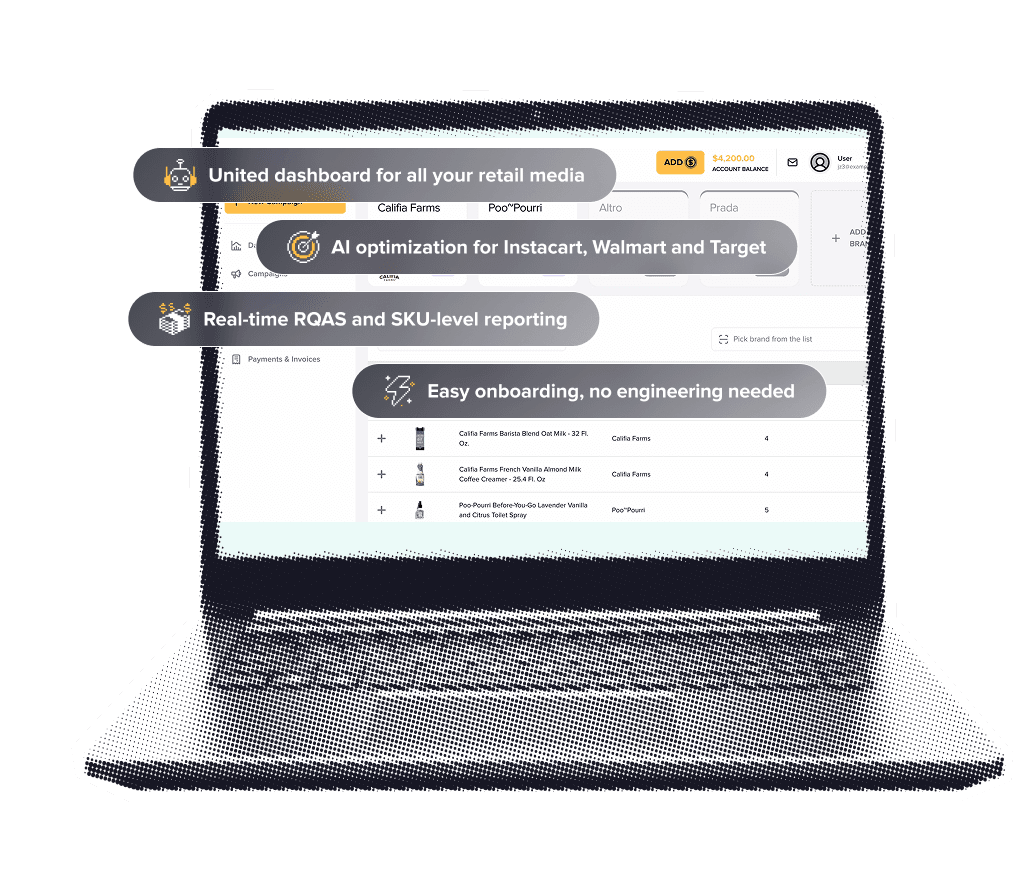
With coverage reaching up to 85% of the U.S. retail audience across more than twenty platforms—including Walmart, Instacart, Amazon, Sprouts, Thrive Market, Target, and Uber—RMIQ expands DBR impact by moving budgets fluidly to the channels, formats, and search terms that are converting now. Unified reporting, workflow consolidation, and SKU‑level insights provide the governance and auditability finance and operations require, reducing manual reconciliation and eliminating multi‑login friction. Real‑time bidding and keyword optimization tighten feedback loops, enabling rapid test‑and‑learn cycles that turn DBR from a periodic exercise into a continuous, compounding advantage. The platform scales from emerging brands to enterprises managing thousands of SKUs, adapting guardrails, pacing, and constraints to business policy without sacrificing speed. Fast onboarding—often in five minutes—accelerates time to value, while dedicated support partners with your team to operationalize playbooks and performance benchmarks.
In short, RMIQ transforms DBR into an always‑on capability: sense demand, decide allocation, and act automatically across retail media, with transparent controls and measurable outcomes. For B2B stakeholders, this means tighter alignment between marketing, sales, and supply chain, clearer forecasting inputs, and provable financial rigor—supported by granular permissions, API access, and exportable reporting—so DBR initiatives scale globally with confidence, compliance, and speed, without adding headcount or introducing operational risk at any scale.
With coverage reaching up to 85% of the U.S. retail audience across more than twenty platforms—including Walmart, Instacart, Amazon, Sprouts, Thrive Market, Target, and Uber—RMIQ expands DBR impact by moving budgets fluidly to the channels, formats, and search terms that are converting now. Unified reporting, workflow consolidation, and SKU‑level insights provide the governance and auditability finance and operations require, reducing manual reconciliation and eliminating multi‑login friction. Real‑time bidding and keyword optimization tighten feedback loops, enabling rapid test‑and‑learn cycles that turn DBR from a periodic exercise into a continuous, compounding advantage. The platform scales from emerging brands to enterprises managing thousands of SKUs, adapting guardrails, pacing, and constraints to business policy without sacrificing speed. Fast onboarding—often in five minutes—accelerates time to value, while dedicated support partners with your team to operationalize playbooks and performance benchmarks.
In short, RMIQ transforms DBR into an always‑on capability: sense demand, decide allocation, and act automatically across retail media, with transparent controls and measurable outcomes. For B2B stakeholders, this means tighter alignment between marketing, sales, and supply chain, clearer forecasting inputs, and provable financial rigor—supported by granular permissions, API access, and exportable reporting—so DBR initiatives scale globally with confidence, compliance, and speed, without adding headcount or introducing operational risk at any scale.

Skills and tools for DBR
Skills needed include process analysis, constraint identification, and workflow optimization. Tools required are production scheduling software, data analysis tools, and real-time monitoring systems.
Our Current Partners
We are already helping leading retailers and platforms grow their retail media businesses, including:
Drop your email
and we’ll show you how to double your retail media ROAS – no strings attached