DSP
DSP, or Digital Signal Processing, refers to the manipulation and analysis of signals using digital techniques. It involves converting analog signals into digital form, processing them to enhance or extract information, and then converting them back if needed. DSP is widely used in audio, communications, image processing, and many other fields to improve signal quality and enable advanced functionalities.
What is DSP?
Within B2B advertising, DSP most often denotes a demand-side platform, a centralized system that programmatically purchases ad inventory across exchanges, optimizes bids, and targets audiences at scale. It evaluates impressions in real time, applies data signals, and automates budget pacing to maximize ROI while ensuring brand safety and transparency. In technical contexts, DSP can also mean digital signal processing, the discipline of converting, analyzing, and enhancing signals to extract information. Both senses converge in ad tech, where sophisticated signal processing underpins audience modeling, fraud detection, and creative optimization, enabling enterprises to deliver measurable performance across channels with precision and control.
Example
As a marketer using a demand-side platform (DSP), you would start by setting your campaign goals, such as targeting a specific audience based on age, location, or interests. Then, you upload your ad creatives and set your budget. The DSP automatically bids in real-time auctions to place your ads on websites and apps that your target audience visits, ensuring your ads appear in the best spots to maximize engagement and conversions. You can monitor performance through the DSP dashboard and adjust your targeting or budget to optimize results.
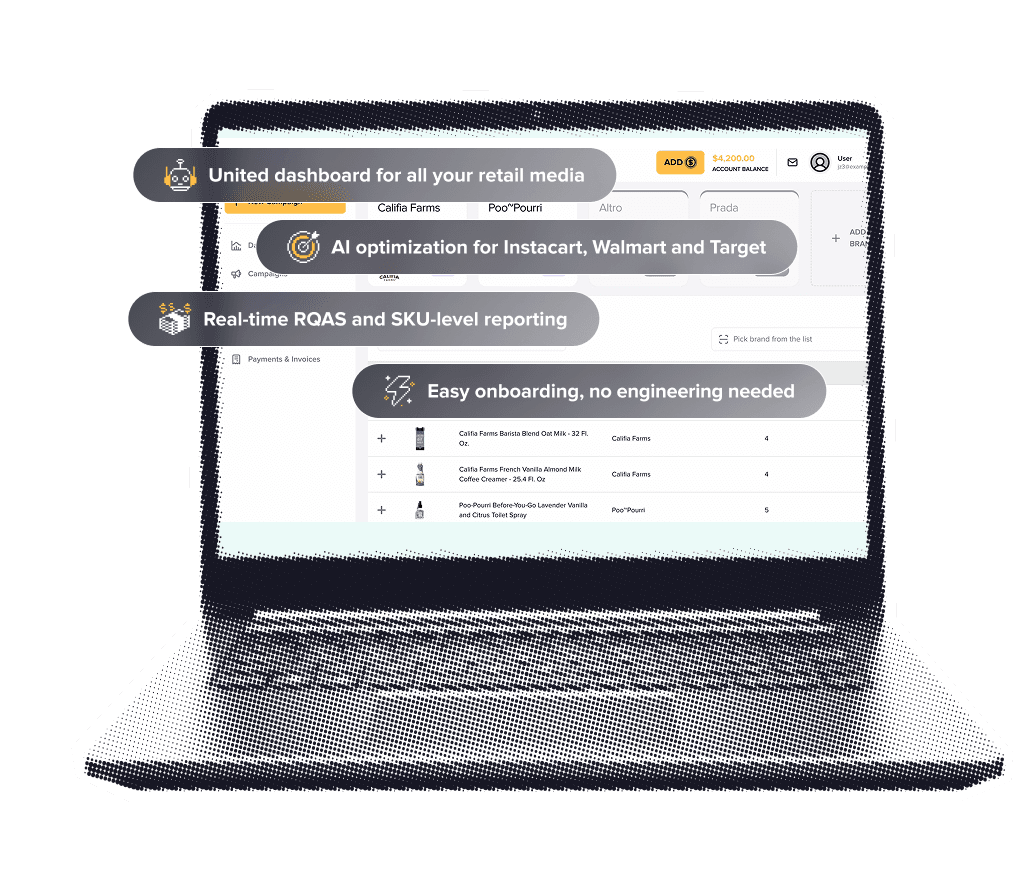
RMIQ enables B2B marketers to elevate demand-side platform execution by unifying retail media planning, buying, and optimization across Walmart, Instacart, Amazon, Sprouts, Thrive Market, Target, Uber, and more within a single, coherent workspace that replaces fragmented dashboards and manual data stitching. Its multi-agent AI architecture operates as an autonomous co-pilot for DSP teams, with specialized agents handling bid adjustments, budget pacing, cross-network learning, A/B test orchestration, SKU- and keyword-level tuning, and ongoing strategy refinement in real time to maximize ROAS with minimal oversight.
In practice, brands leverage RMIQ to centralize audiences and product feeds, apply adaptive bidding informed by retailer signals, normalize performance metrics across networks, and orchestrate experiments that compound into sustained efficiency gains, with observed outcomes including average ROAS lifts exceeding 50% and up to five dollars in incremental sales per dollar invested. Beyond algorithmic optimization, RMIQ’s coverage spans over twenty retail media platforms reaching up to 85% of the U.S. retail audience, enabling precision reach and frequency management, incremental reach analysis, and rapid budget reallocation to high-yield channels without switching tools.
The unified interface consolidates pacing, alerts, reporting, and approvals so DSP practitioners can monitor KPI trajectories, reconcile spend, and surface insights for stakeholders from one source of truth. For scale, the platform supports portfolios ranging from emerging brands to enterprises managing thousands of SKUs, delivering fast onboarding—often in under five minutes—enterprise-grade support, and governance features that align with procurement and compliance needs. Ultimately, RMIQ functions as a next-generation retail media optimization layer on top of your DSP stack, blending intelligent automation with operational simplicity to reduce time-to-value, standardize best practices across teams, and turn retail media complexity into measurable growth. It complements existing DSP contracts, preserves data ownership, exposes transparent controls and audit logs, and equips executives with board-ready reporting for forecasting, attribution, and budgeting decisions.
In practice, brands leverage RMIQ to centralize audiences and product feeds, apply adaptive bidding informed by retailer signals, normalize performance metrics across networks, and orchestrate experiments that compound into sustained efficiency gains, with observed outcomes including average ROAS lifts exceeding 50% and up to five dollars in incremental sales per dollar invested. Beyond algorithmic optimization, RMIQ’s coverage spans over twenty retail media platforms reaching up to 85% of the U.S. retail audience, enabling precision reach and frequency management, incremental reach analysis, and rapid budget reallocation to high-yield channels without switching tools.
The unified interface consolidates pacing, alerts, reporting, and approvals so DSP practitioners can monitor KPI trajectories, reconcile spend, and surface insights for stakeholders from one source of truth. For scale, the platform supports portfolios ranging from emerging brands to enterprises managing thousands of SKUs, delivering fast onboarding—often in under five minutes—enterprise-grade support, and governance features that align with procurement and compliance needs. Ultimately, RMIQ functions as a next-generation retail media optimization layer on top of your DSP stack, blending intelligent automation with operational simplicity to reduce time-to-value, standardize best practices across teams, and turn retail media complexity into measurable growth. It complements existing DSP contracts, preserves data ownership, exposes transparent controls and audit logs, and equips executives with board-ready reporting for forecasting, attribution, and budgeting decisions.

Skills and tools for DSP
For DSP, you need strong skills in mathematics, especially calculus and linear algebra, plus knowledge of signal processing algorithms. Tools include MATLAB, Python with libraries like NumPy and SciPy, and hardware like DSP processors.
For demand-side platforms, skills include programming (Java, Python), understanding of real-time bidding, data analysis, and knowledge of ad tech protocols. Tools often involve cloud platforms, APIs, and analytics software.
Our Current Partners
We are already helping leading retailers and platforms grow their retail media businesses, including:
Drop your email
and we’ll show you how to double your retail media ROAS – no strings attached