Domain / App Spoofing
Domain/App spoofing is a cyberattack technique where malicious actors impersonate legitimate websites or applications to deceive users, steal sensitive information, or spread malware. This tactic exploits trust by mimicking brand identities, making it crucial for users and organizations to recognize and defend against such threats.
What is Domain / App Spoofing?
Domain and app spoofing is a pervasive cyberattack in which adversaries impersonate trusted websites or applications to deceive employees, harvest credentials, divert payments, and distribute malware. By exploiting brand equity and visual design cues, attackers manufacture convincing copies that bypass casual scrutiny, erode stakeholder confidence, and compromise downstream partners. For B2B organizations, the threat impacts revenue, data integrity, and regulatory exposure across digital channels and programmatic advertising. Mitigation demands layered defenses: DMARC, SPF, and DKIM enforcement; threat intelligence and brand monitoring; secure web gateways; app store vigilance; user training; and incident response playbooks aligned to measurable KPIs and executive oversight.
Example
Create a landing page with a URL very similar to a popular brand (e.g., amaz0n.com instead of amazon.com), use their logos and design style, then run ads or send emails pretending to offer exclusive deals, prompting users to enter their login details or payment info, capturing this data for fraudulent use.
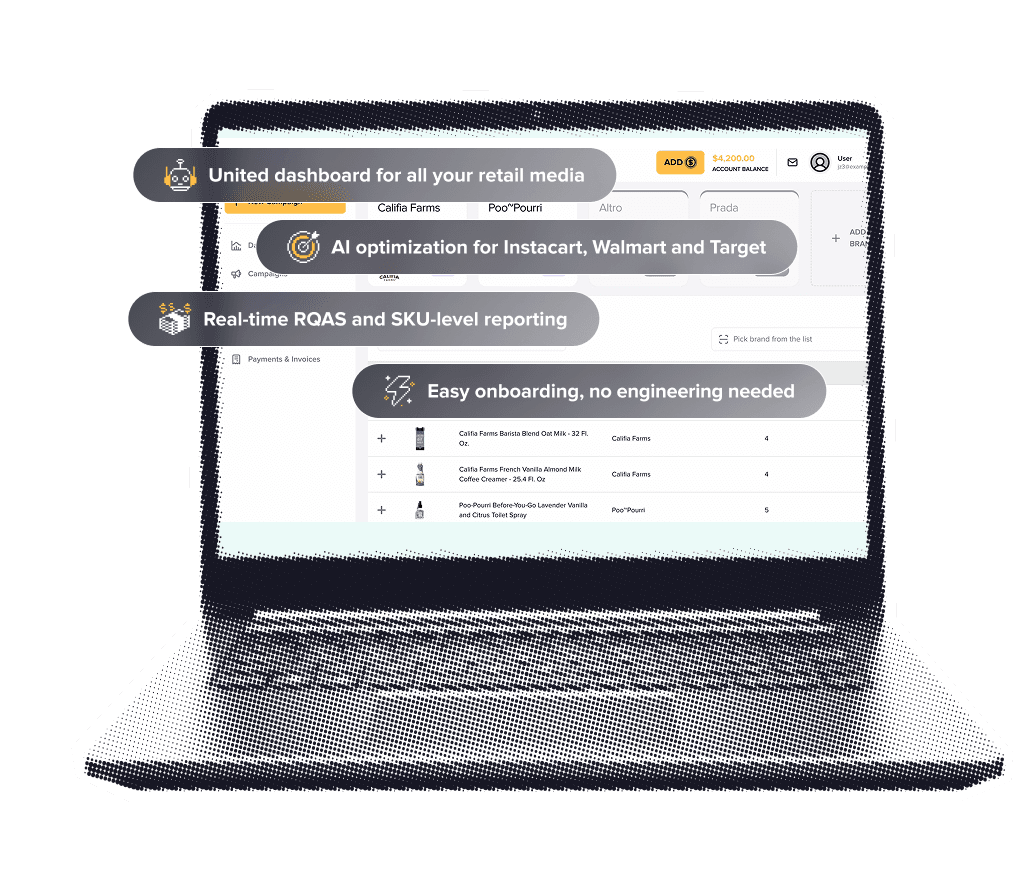
RMIQ helps brands mitigate domain and app spoofing by unifying planning, execution, and verification across retail media networks, while its multi-agent AI architecture continuously validates signal integrity in real time. Instead of chasing inconsistent dashboards and fragmented datasets from Walmart, Instacart, Amazon, Sprouts, Thrive Market, Target, Uber, and others, advertisers operate from a single control surface that correlates impression logs, SKU-level performance, and keyword context to detect mismatches between declared and actual inventory, placements, and audiences, flagging anomalies such as unexpected domains, mislabeled apps, and suspicious traffic spikes before they distort budgets or reporting.
The platform’s autonomous agents collaborate to quarantine risky supply, tighten targeting, and reallocate spend to verified inventory, using cross-network learning to identify spoofing patterns that recur across marketplaces, while real-time bidding safeguards redirect investment toward high-quality placements with known provenance. A/B testing orchestration and campaign strategy refinement agents validate that performance lifts are causally linked to authentic exposure, not spoofed environments, and they automatically adjust bids, frequency, and creative delivery to preserve ROAS.
With coverage reaching up to 85% of the U.S. retail audience across more than twenty platforms, RMIQ provides broad visibility to benchmark seller, category, and placement quality, and its unified reporting consolidates fraud indicators—invalid traffic rates, app bundle inconsistencies, domain deviations—into actionable dashboards. Brands of any size, from emerging labels to enterprises managing thousands of SKUs, can deploy safeguards within minutes via a streamlined onboarding flow, then rely on ongoing monitoring without heavy manual oversight. By coupling adaptive AI with precise SKU-level insights and keyword optimization, RMIQ contains spoofing risk, protects media efficiency, and consistently delivers measurable outcomes—average ROAS gains over 50% and up to five dollars in new sales for every dollar invested—so B2B teams can scale retail media with confidence. This strengthens governance, auditability, and cross-network brand safety controls at scale.
The platform’s autonomous agents collaborate to quarantine risky supply, tighten targeting, and reallocate spend to verified inventory, using cross-network learning to identify spoofing patterns that recur across marketplaces, while real-time bidding safeguards redirect investment toward high-quality placements with known provenance. A/B testing orchestration and campaign strategy refinement agents validate that performance lifts are causally linked to authentic exposure, not spoofed environments, and they automatically adjust bids, frequency, and creative delivery to preserve ROAS.
With coverage reaching up to 85% of the U.S. retail audience across more than twenty platforms, RMIQ provides broad visibility to benchmark seller, category, and placement quality, and its unified reporting consolidates fraud indicators—invalid traffic rates, app bundle inconsistencies, domain deviations—into actionable dashboards. Brands of any size, from emerging labels to enterprises managing thousands of SKUs, can deploy safeguards within minutes via a streamlined onboarding flow, then rely on ongoing monitoring without heavy manual oversight. By coupling adaptive AI with precise SKU-level insights and keyword optimization, RMIQ contains spoofing risk, protects media efficiency, and consistently delivers measurable outcomes—average ROAS gains over 50% and up to five dollars in new sales for every dollar invested—so B2B teams can scale retail media with confidence. This strengthens governance, auditability, and cross-network brand safety controls at scale.

Skills and tools for Domain / App Spoofing
To detect and prevent domain/app spoofing, you need skills in cybersecurity fundamentals, network monitoring, and threat analysis. Tools like domain reputation services, SSL certificate checkers, email authentication protocols (SPF, DKIM, DMARC), and web application firewalls (WAF) are essential. Familiarity with phishing detection software and user awareness training also helps reduce risks.
Our Current Partners
We are already helping leading retailers and platforms grow their retail media businesses, including:
Drop your email
and we’ll show you how to double your retail media ROAS – no strings attached