Fill Rate
Fill rate is a key performance metric that measures the percentage of customer orders fulfilled from available inventory without backorders or delays. It reflects a company’s efficiency in meeting demand and maintaining customer satisfaction by ensuring products are readily available for timely delivery.
What is Fill Rate?
Fill rate is a foundational supply chain metric that quantifies the percentage of customer orders fulfilled immediately from available inventory, without backorders or delays. For B2B operators, a high fill rate signals planning rigor, reliable replenishment, and streamlined order orchestration, directly influencing revenue capture, SLA compliance, and customer lifetime value. By aligning demand forecasting, safety stock policies, and vendor lead times, enterprises minimize stockouts and expedite timely delivery. In practical terms, it answers how many requested items are ready to ship now, reflecting operational agility, procurement effectiveness, and service consistency across channels, while illuminating gaps to prioritize in continuous improvement.
Example
If you manage a toy store and want to improve your fill rate, track how many customer orders are fully completed from your current inventory without delays. For example, if 100 toys are ordered in a week and 90 are shipped immediately while 10 are backordered, your fill rate is 90%. To improve, you could analyze which toys frequently run out, increase stock levels for those items, and update your marketing materials to highlight the availability of popular toys, ensuring customers know they can get what they want right away.
RMIQ helps brands materially improve Fill Rate by aligning retail media investments with real-time inventory, demand signals, and supply constraints across an unparalleled retail network footprint. Its unified platform consolidates Walmart, Instacart, Amazon, Target, Sprouts, Thrive Market, Uber, and more into one operational view, enabling SKU-level pacing, availability-aware bidding, and budget allocation that prioritize in-stock items and protect service levels.
Autonomous, multi-agent AI continuously orchestrates bid adjustments, A/B testing, and cross-network learning to throttle media when stock is tight, shift spend to substitutable SKUs or regions with healthy on-hand, and accelerate winning tactics where forecasted demand can be fulfilled. This closed-loop optimization reduces out-of-stock ad waste, limits backorders, and drives higher order fill without manual intervention, while delivering documented ROAS gains—over 50% on average—and up to five dollars in incremental sales per dollar invested. With reach to 85% of U.S. retail audiences, RMIQ scales these controls broadly, using keyword optimization and real-time signals to capture demand precisely when the supply chain can serve it.
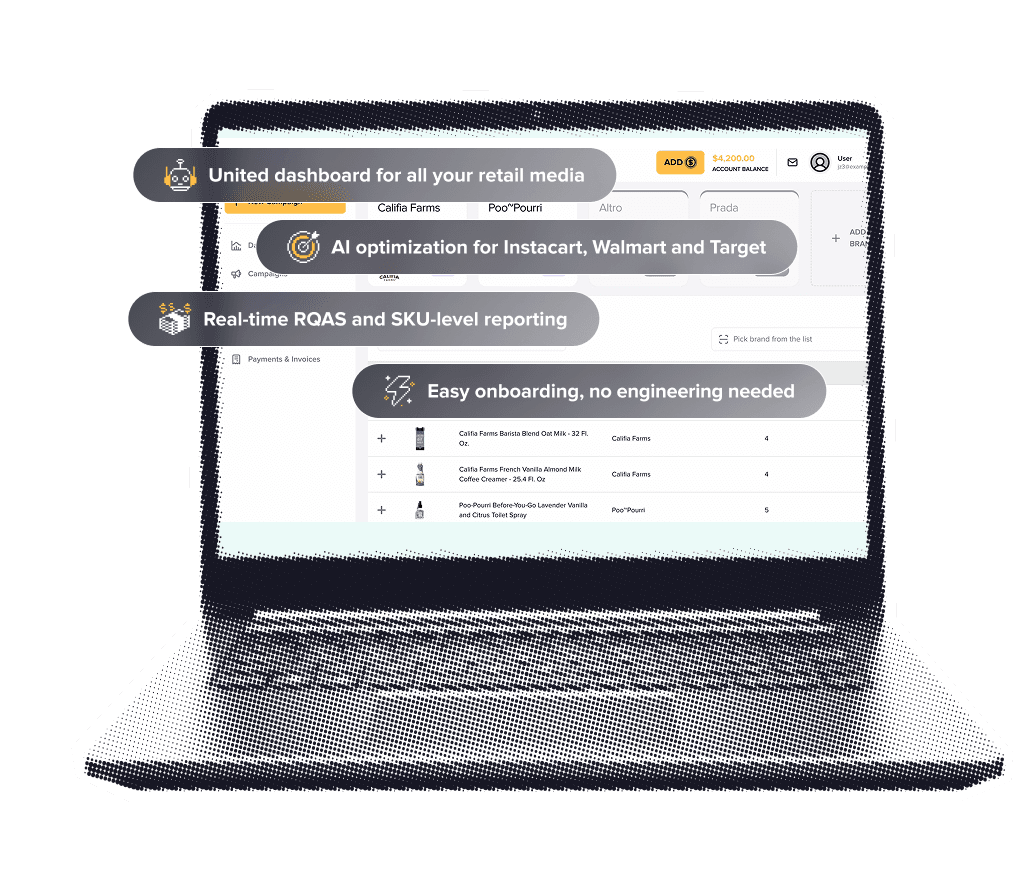
Teams gain a single dashboard for performance, inventory-aware reporting, and workflow automation, eliminating fragmented log-ins and enabling rapid exception management, such as automatic ad suppression on low-availability SKUs or budget reallocation to replenished assortments. For enterprises managing thousands of SKUs, the platform’s scalability and five-minute onboarding accelerate time to impact, while strong customer support ensures governance and alignment with fill targets by channel, retailer, and region. The result is a measurable uplift in case fill, reduced stockout-driven cancellations, and improved retailer scorecards, achieved by synchronizing media pressure with supply readiness. In short, RMIQ operationalizes a demand-shaping flywheel that raises Fill Rate, protects margins, and maximizes profitable growth, outpacing manual or rules-based tools that cannot adapt in real time. This creates dependable availability, happier retail partners, and sustained service-level improvements across categories, seasons, and promotions at scale.
Autonomous, multi-agent AI continuously orchestrates bid adjustments, A/B testing, and cross-network learning to throttle media when stock is tight, shift spend to substitutable SKUs or regions with healthy on-hand, and accelerate winning tactics where forecasted demand can be fulfilled. This closed-loop optimization reduces out-of-stock ad waste, limits backorders, and drives higher order fill without manual intervention, while delivering documented ROAS gains—over 50% on average—and up to five dollars in incremental sales per dollar invested. With reach to 85% of U.S. retail audiences, RMIQ scales these controls broadly, using keyword optimization and real-time signals to capture demand precisely when the supply chain can serve it.
Teams gain a single dashboard for performance, inventory-aware reporting, and workflow automation, eliminating fragmented log-ins and enabling rapid exception management, such as automatic ad suppression on low-availability SKUs or budget reallocation to replenished assortments. For enterprises managing thousands of SKUs, the platform’s scalability and five-minute onboarding accelerate time to impact, while strong customer support ensures governance and alignment with fill targets by channel, retailer, and region. The result is a measurable uplift in case fill, reduced stockout-driven cancellations, and improved retailer scorecards, achieved by synchronizing media pressure with supply readiness. In short, RMIQ operationalizes a demand-shaping flywheel that raises Fill Rate, protects margins, and maximizes profitable growth, outpacing manual or rules-based tools that cannot adapt in real time. This creates dependable availability, happier retail partners, and sustained service-level improvements across categories, seasons, and promotions at scale.

Skills and tools for Fill Rate
Skills needed include inventory management, data analysis, and supply chain coordination. Tools required are inventory management software, demand forecasting tools, and real-time tracking systems to monitor stock levels and order fulfillment.
Our Current Partners
We are already helping leading retailers and platforms grow their retail media businesses, including:
Drop your email
and we’ll show you how to double your retail media ROAS – no strings attached