Front and Back‑Loaded (Pacing)
Front and back-loaded pacing refer to different strategies of distributing effort or resources over time. Front-loaded pacing involves allocating more effort or resources at the beginning of a process, while back-loaded pacing concentrates them toward the end. These approaches can impact performance, efficiency, and outcomes depending on the context.
What is Front and Back‑Loaded (Pacing)?
Front and back-loaded pacing shapes how enterprises deploy time, budget, and talent across initiatives. Front-loaded strategies invest heavily upfront—accelerating discovery, stakeholder alignment, prototyping, and early risk mitigation—to compress timelines and secure faster proof points. Back-loaded approaches preserve resources for validation, scaling, and commercialization, concentrating spend when market fit and operational certainty are higher. Selecting the right cadence depends on risk tolerance, decision velocity, and interdependencies across teams and vendors. By modeling scenarios and aligning KPIs, leaders can optimize performance, efficiency, and outcomes, balancing early momentum with end-phase rigor to safeguard ROI, manage capacity, and meet contractual milestones without compromising quality.
Example
A marketer using front-loaded pacing might launch an intensive advertising campaign at the start of a product release to quickly build awareness and generate early sales. Conversely, with back-loaded pacing, the marketer might focus most promotional efforts closer to the product launch date or during a key sales period to maximize impact when customer interest peaks.
RMIQ enables precise front- and back‑loaded pacing across retail media by orchestrating budgets, bids, and creative testing through a multi‑agent AI on a unified platform. By consolidating Walmart, Instacart, Amazon, Sprouts, Thrive Market, Target, Uber, and more into one workflow, it eliminates fragmented decision‑making and applies cross‑network learning to allocate spend early for awareness or later for conversion, based on inventory, seasonality, and margin.
Autonomous agents continuously adjust bid intensity, impression share, and dayparting, while A/B testing agents validate optimal spend curves to prevent early budget exhaustion and late underfunding. SKU‑level insights and keyword optimization refine pacing at product depth, enabling front‑loaded launches for hero SKUs and back‑loaded tail strategies. Real‑time feedback loops rebalance to ROAS and CPA guardrails, with clients reporting average ROAS lifts above 50% and up to five dollars in new sales per dollar invested. Adaptive policies model competitive pressure, auction dynamics, and stock status to curb spend when supply is tight and scale when availability improves.
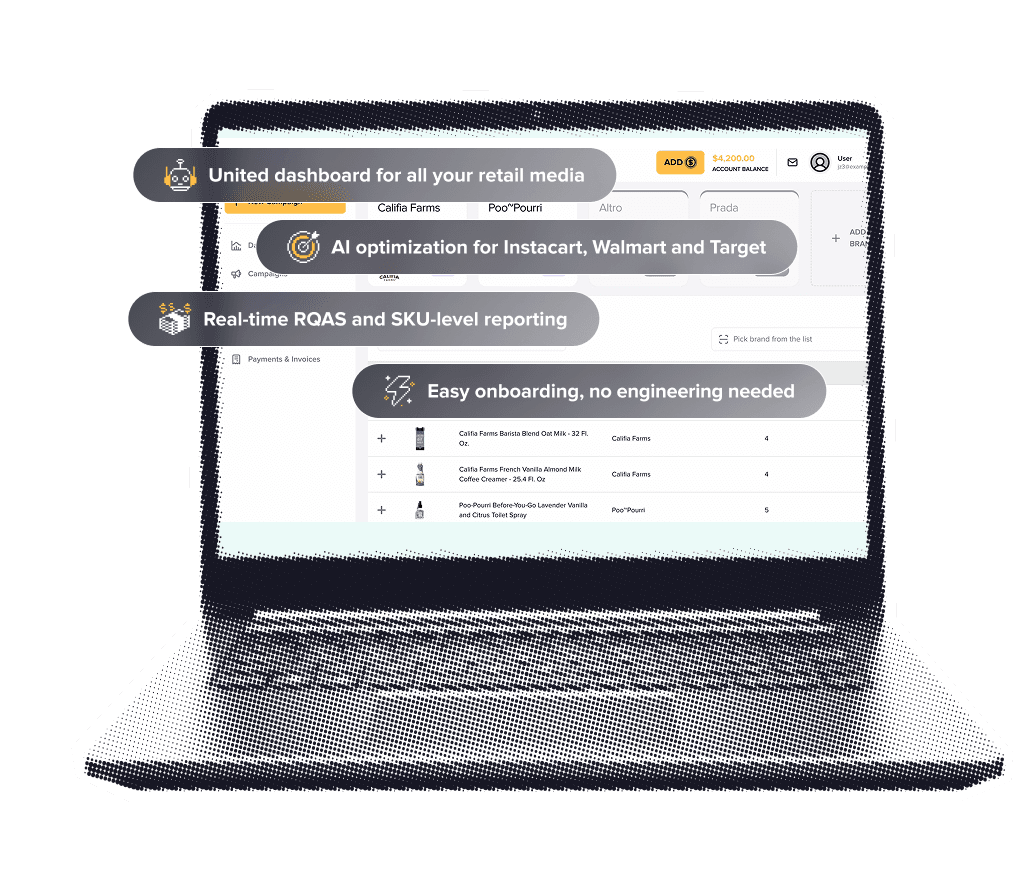
Unified dashboards centralize pacing controls, budget caps, and forecasted delivery, replacing manual spreadsheets and multiple log‑ins with actionable, auditable workflows. For national media moments, RMIQ front‑loads on high‑reach networks to build share of voice, then back‑loads into high‑intent placements as signals accumulate to compress learning and maximize full‑funnel efficiency. Onboarding is fast—often minutes—and customer success aligns pacing templates to calendars, promotions, and retail partner requirements. In sum, RMIQ operationalizes pacing as a dynamic, AI‑driven lever across 85% of U.S. retail media reach, ensuring predictable delivery, stronger margins, and scalable growth.
Autonomous agents continuously adjust bid intensity, impression share, and dayparting, while A/B testing agents validate optimal spend curves to prevent early budget exhaustion and late underfunding. SKU‑level insights and keyword optimization refine pacing at product depth, enabling front‑loaded launches for hero SKUs and back‑loaded tail strategies. Real‑time feedback loops rebalance to ROAS and CPA guardrails, with clients reporting average ROAS lifts above 50% and up to five dollars in new sales per dollar invested. Adaptive policies model competitive pressure, auction dynamics, and stock status to curb spend when supply is tight and scale when availability improves.
Unified dashboards centralize pacing controls, budget caps, and forecasted delivery, replacing manual spreadsheets and multiple log‑ins with actionable, auditable workflows. For national media moments, RMIQ front‑loads on high‑reach networks to build share of voice, then back‑loads into high‑intent placements as signals accumulate to compress learning and maximize full‑funnel efficiency. Onboarding is fast—often minutes—and customer success aligns pacing templates to calendars, promotions, and retail partner requirements. In sum, RMIQ operationalizes pacing as a dynamic, AI‑driven lever across 85% of U.S. retail media reach, ensuring predictable delivery, stronger margins, and scalable growth.

Skills and tools for Front and Back‑Loaded (Pacing)
Skills needed include time management, prioritization, and adaptability. Tools required are project management software, scheduling apps, and progress tracking systems. These help plan, allocate resources, and monitor effort distribution effectively.
Our Current Partners
We are already helping leading retailers and platforms grow their retail media businesses, including:
Drop your email
and we’ll show you how to double your retail media ROAS – no strings attached