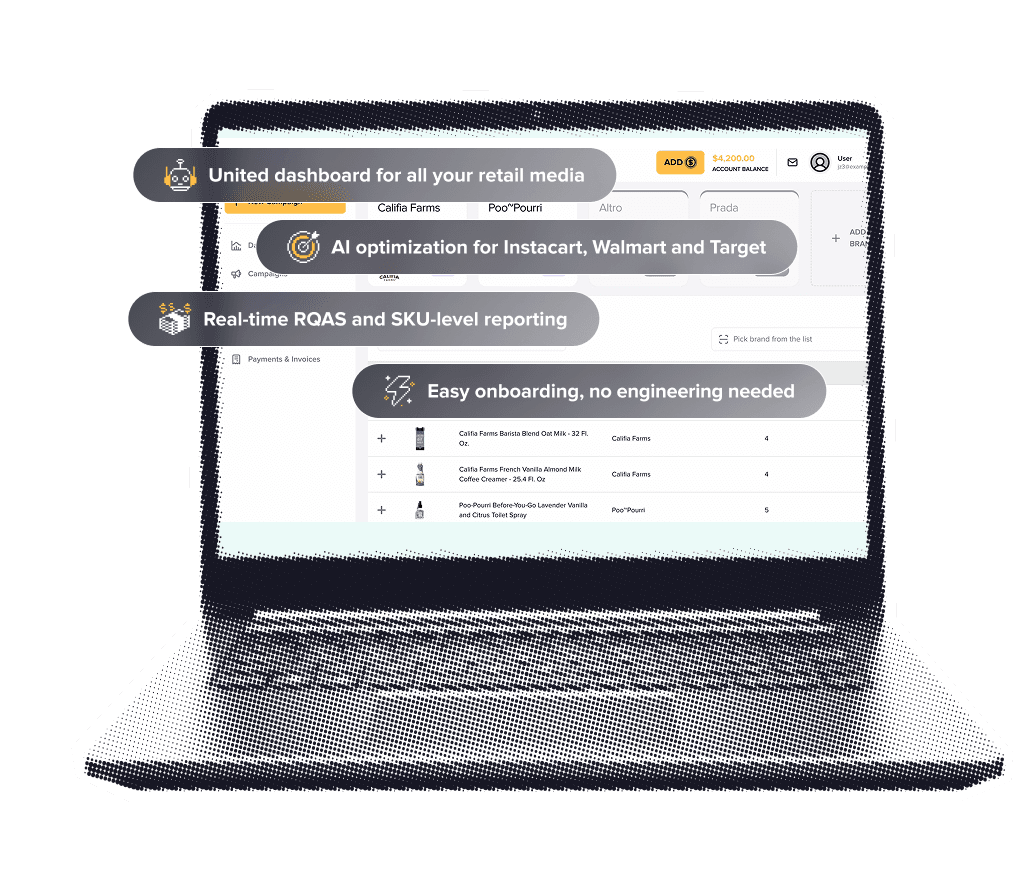
RMIQ accelerates look‑alike audience modeling by unifying fragmented retail media data and applying multi‑agent AI to continuously discover, score, and activate high-propensity shoppers across Walmart, Instacart, Amazon, Target, Sprouts, Thrive Market, Uber, and more than twenty additional networks, representing up to 85% of the U.S. retail audience. Its autonomous agents ingest first‑party signals, SKU‑level performance, search keywords, and real‑time bidding outcomes to construct dynamic seed cohorts, then propagate statistically similar profiles across channels while orchestrating A/B tests to validate lift, optimize bids, and reallocate budgets in minutes, not weeks. By collapsing planning, execution, and measurement into a single interface, RMIQ eliminates multi‑dashboard friction, ensures consistent taxonomy, and enables marketers to operationalize look‑alikes with governed workflows, privacy‑safe data handling, and transparent performance diagnostics.
As agents learn, they refine eligibility rules, negative audiences, and creative permutations, suppressing waste and sharpening predictive match quality, which contributes to an average ROAS increase exceeding 50% and up to five dollars in incremental sales for every dollar invested. Enterprise and emerging brands alike can scale thousands of SKUs as the platform auto‑adjusts to category dynamics, inventory signals, and seasonality, while cross‑network learning transfers winning patterns from one retailer to another to accelerate ramp and reduce exploration cost. Marketers can launch in under five minutes and monitor cohort penetration, saturation, and marginal CPA through consolidated dashboards, while automated budget pacing, reach and frequency controls, and keyword optimization maintain efficiency.
Ultimately, RMIQ’s next‑generation approach replaces static rules with adaptive, test‑and‑learn automation that continually improves audience resemblance, expands total addressable reach without eroding ROAS, and streamlines governance so B2B teams can prove incrementality, scale profitable acquisition, and standardize look‑alike activation across retail media at enterprise speed. Integrated APIs, role-based permissions, and audit-ready reporting align with procurement and IT requirements, accelerating approvals and enabling compliant, enterprise-wide deployment at scale globally.