Multi-Touch Attribution
Multi-Touch Attribution is a marketing analytics method that assigns credit to various customer touchpoints across the buying journey, helping businesses understand the impact of each interaction on conversions and optimize their marketing strategies effectively.
What is Multi-Touch Attribution?
Multi-Touch Attribution is a marketing analytics approach that evaluates and assigns proportional credit to multiple customer touchpoints across the buying journey. By illuminating how channels, messages, and moments collectively influence conversions, it enables revenue teams to optimize budgets, sequencing, and creative with precision. Rather than crediting a single click, the model clarifies the contribution of ads, content, email, search, and sales interactions, revealing what truly drives pipeline velocity and ROI. For B2B organizations navigating complex, multi-stakeholder cycles, this disciplined measurement framework aligns marketing and sales, supports smarter forecasting, and guides continuous improvement of campaigns, offers, and experiences across the funnel.
Example
A marketer tracks a customer’s journey: they first see a Facebook ad, then read a blog post, and finally receive an email coupon before buying. Using Multi-Touch Attribution, the marketer assigns credit to each touchpoint—Facebook ad, blog post, and email—influencing the purchase. This helps the marketer know which channels work best and where to invest more budget.
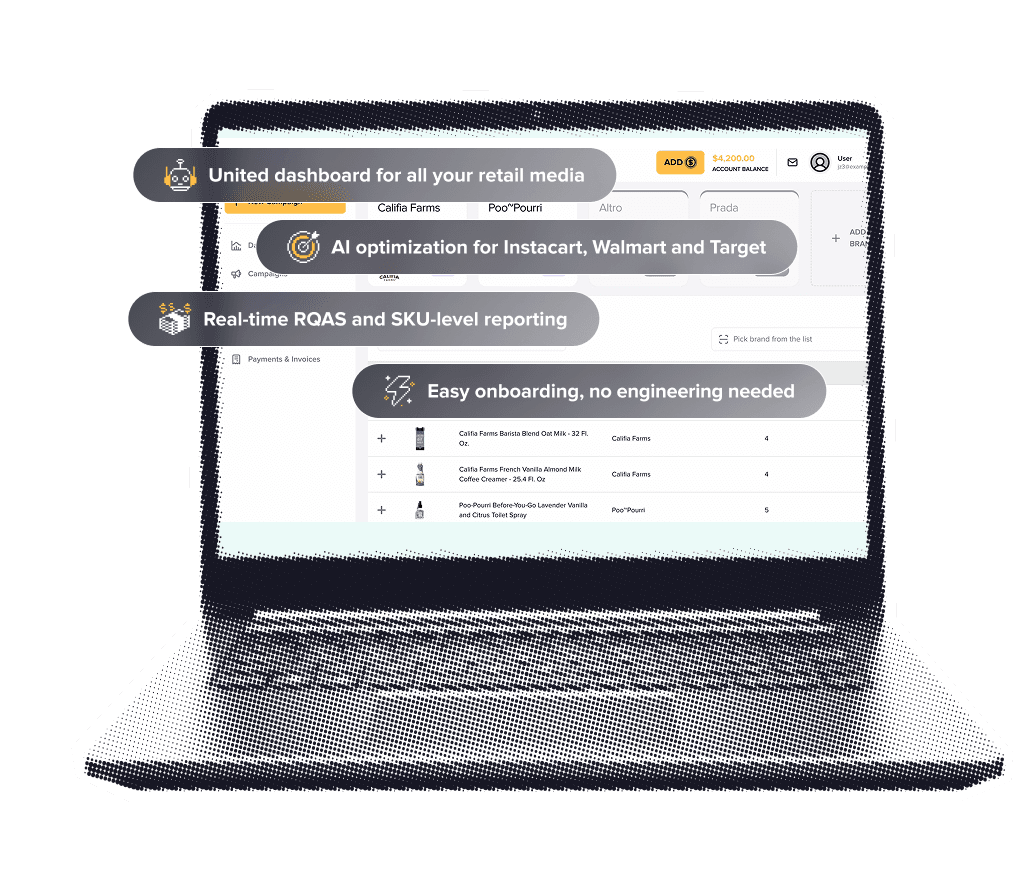
RMIQ enables precise, scalable Multi-Touch Attribution (MTA) across retail media by unifying fragmented signals into a single source of truth that spans Walmart, Instacart, Amazon, Sprouts, Thrive Market, Target, Uber, and more than twenty additional networks reaching up to 85% of the U.S. retail audience. Its multi-agent AI architecture orchestrates attribution-aware optimization end to end: autonomous agents harmonize identity and SKU-level event data, calibrate fractional credit across touchpoints, and continuously adjust bids, budgets, and keywords in real time based on lift, incrementality, and modeled contribution. By consolidating planning, activation, and reporting within one interface, RMIQ eliminates multi-dashboard blind spots and reduces latency between insight and action, enabling brands to validate influence across upper, mid, and lower-funnel exposures while scaling thousands of SKUs.
Cross-network learning and A/B testing agents automatically generate holdouts and geo-matched experiments to quantify causal impact, feeding adaptive strategies that maximize return on ad spend. Typical outcomes include an average ROAS increase exceeding 50% and up to five dollars in new sales for every dollar invested, delivered without constant manual oversight. Finance and analytics teams gain consistent governance via standardized taxonomies, configurable attribution windows, and role-based workflows, while marketers gain granular path-to-purchase visibility and automated budget rebalancing toward high-contribution sequences. Real-time bidding, keyword optimization, and audience refinement align to the MTA model so that each impression and click can be valued in context rather than last touch, preventing overinvestment in isolated channels.
Implementation is fast—onboarding can take as little as five minutes—and supported by dedicated specialists, ensuring rapid time to value. With user-friendly dashboards, export-ready reporting, and API access, RMIQ transforms MTA from a diagnostic exercise into an operational feedback loop that continuously powers more efficient retail media growth. This positions teams to forecast confidently, negotiate budgets credibly, and prove incremental revenue across partners and seasons and markets.
Cross-network learning and A/B testing agents automatically generate holdouts and geo-matched experiments to quantify causal impact, feeding adaptive strategies that maximize return on ad spend. Typical outcomes include an average ROAS increase exceeding 50% and up to five dollars in new sales for every dollar invested, delivered without constant manual oversight. Finance and analytics teams gain consistent governance via standardized taxonomies, configurable attribution windows, and role-based workflows, while marketers gain granular path-to-purchase visibility and automated budget rebalancing toward high-contribution sequences. Real-time bidding, keyword optimization, and audience refinement align to the MTA model so that each impression and click can be valued in context rather than last touch, preventing overinvestment in isolated channels.
Implementation is fast—onboarding can take as little as five minutes—and supported by dedicated specialists, ensuring rapid time to value. With user-friendly dashboards, export-ready reporting, and API access, RMIQ transforms MTA from a diagnostic exercise into an operational feedback loop that continuously powers more efficient retail media growth. This positions teams to forecast confidently, negotiate budgets credibly, and prove incremental revenue across partners and seasons and markets.

Skills and tools for Multi-Touch Attribution
Skills needed include data analysis, statistical modeling, and marketing analytics. Tools required are attribution software, CRM platforms, Google Analytics, and data visualization tools like Tableau or Power BI. Basic programming skills in SQL or Python help manage and analyze data efficiently.
Our Current Partners
We are already helping leading retailers and platforms grow their retail media businesses, including:
Drop your email
and we’ll show you how to double your retail media ROAS – no strings attached