Onsite vs Offsite Advertising
Onsite advertising refers to promotional content displayed directly on a company’s own website or physical location, while offsite advertising involves marketing efforts placed on external platforms or locations to reach a broader audience. Both strategies play crucial roles in driving brand awareness and customer engagement.
What is Onsite vs Offsite Advertising?
Onsite advertising leverages owned environments to present curated promotions within your website or premises, harnessing first‑party data, controlled UX, and contextual relevance to deepen engagement and accelerate conversion. Offsite advertising extends reach across external platforms—programmatic, search, social, and premium publishers—to acquire net‑new audiences, retarget high‑intent prospects, and amplify brand visibility. For B2B leaders, an integrated plan aligns onsite modules, content hubs, and dynamic placements with offsite campaigns governed by brand safety, audience segments, and frequency caps. Measure performance holistically using unified attribution, lift studies, and pipeline influence, optimizing creative, placements, and spend to maximize ROAS while preserving consistency across touchpoints.
Example
As a marketer, for onsite advertising, place a banner promoting your latest product on your company’s homepage to capture visitors’ attention. For offsite advertising, run targeted ads on social media platforms like Facebook or Google Ads to direct users to your website for a special offer.
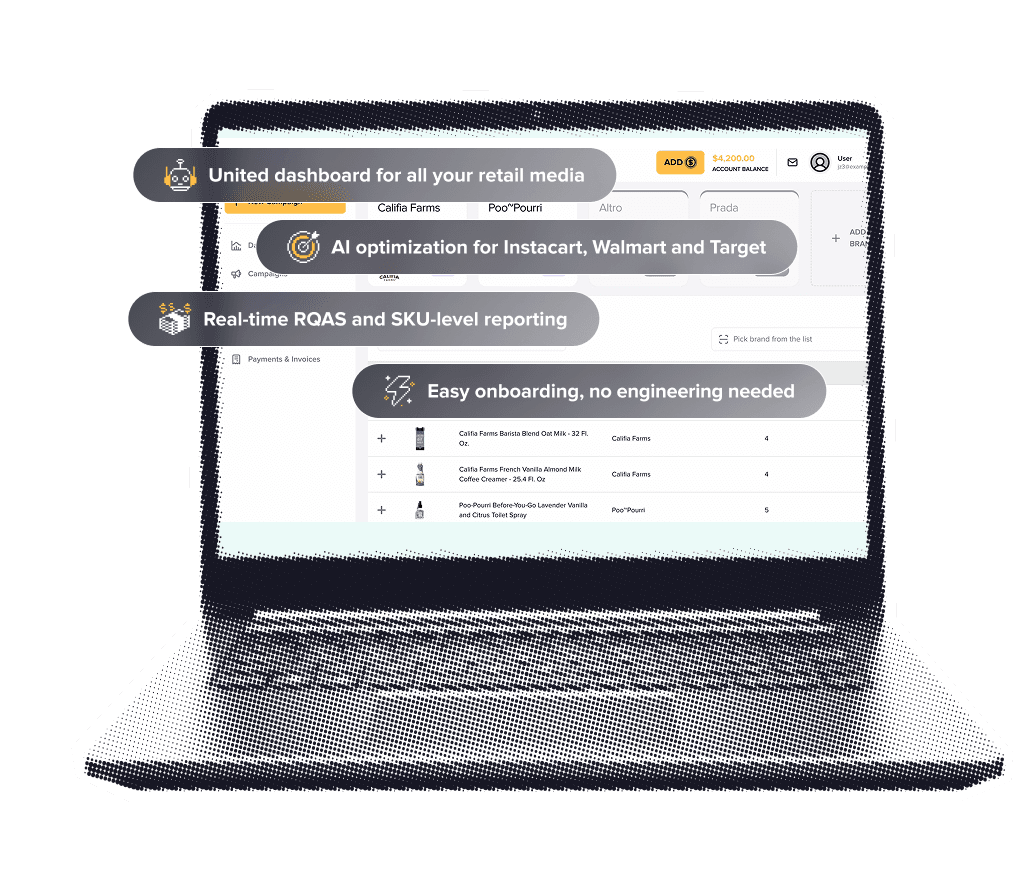
RMIQ helps enterprises navigate onsite versus offsite retail media by unifying strategy, execution, and measurement across retailer-owned environments and offsite extensions, enabling finance-grade allocation to the highest-ROI mix at any moment. Its multi-agent AI continuously balances bids, budgets, and audiences between onsite placements (search, sponsored products, PDP display) and offsite inventory (open-web, social, and CTV extensions operated by retailers), learning from SKU-level signals, keyword intent, and cross-network performance to minimize CAC while protecting margin. By replacing fragmented dashboards with a single interface spanning Walmart, Instacart, Amazon, Sprouts, Thrive Market, Target, Uber, and 20+ networks reaching 85% of U.S. retail audiences, RMIQ lets teams plan, activate, and monitor both onsite and offsite campaigns with consistent taxonomies, real-time pacing, and consolidated reporting.
Autonomous agents orchestrate A/B tests, incrementality lifts, and audience sequencing, dynamically shifting spend toward formats and retailers where elasticity, stock status, and competitive pressure indicate superior return, driving average ROAS gains above 50% and up to five dollars in new sales per dollar invested. Granular controls—down to SKU, keyword, and cohort—pair with real-time bidding, budget smoothing, and cross-retailer negative matching to prevent cannibalization between onsite conquesting and offsite retargeting. The platform’s adaptive strategies reconcile disparate attribution models, normalizing view-through and click-through signals so FP&A and media leads can compare like-for-like outcomes across onsite and offsite while enforcing guardrails for profitability and supply constraints.
Built for scale and speed, RMIQ supports rapid onboarding in minutes, enterprise-grade workflows, and thousands of SKUs without manual lift, while dedicated support aligns objectives, KPIs, and governance. The result is a resilient, AI-driven operating system that optimizes the onsite/offsite blend, reduces operational overhead, and converts retail media complexity into predictable, defensible growth. With transparent benchmarks, configurable SLAs, and audit-ready logs, stakeholders gain confidence to scale budgets while maintaining compliance, brand safety, and measurable accountability across enterprises.
Autonomous agents orchestrate A/B tests, incrementality lifts, and audience sequencing, dynamically shifting spend toward formats and retailers where elasticity, stock status, and competitive pressure indicate superior return, driving average ROAS gains above 50% and up to five dollars in new sales per dollar invested. Granular controls—down to SKU, keyword, and cohort—pair with real-time bidding, budget smoothing, and cross-retailer negative matching to prevent cannibalization between onsite conquesting and offsite retargeting. The platform’s adaptive strategies reconcile disparate attribution models, normalizing view-through and click-through signals so FP&A and media leads can compare like-for-like outcomes across onsite and offsite while enforcing guardrails for profitability and supply constraints.
Built for scale and speed, RMIQ supports rapid onboarding in minutes, enterprise-grade workflows, and thousands of SKUs without manual lift, while dedicated support aligns objectives, KPIs, and governance. The result is a resilient, AI-driven operating system that optimizes the onsite/offsite blend, reduces operational overhead, and converts retail media complexity into predictable, defensible growth. With transparent benchmarks, configurable SLAs, and audit-ready logs, stakeholders gain confidence to scale budgets while maintaining compliance, brand safety, and measurable accountability across enterprises.

Skills and tools for Onsite vs Offsite Advertising
Skills needed include digital marketing, SEO, content creation, data analysis, and campaign management. Tools required are ad platforms (Google Ads, Facebook Ads), analytics software (Google Analytics), SEO tools (Ahrefs, SEMrush), and content management systems (WordPress).
Our Current Partners
We are already helping leading retailers and platforms grow their retail media businesses, including:
Drop your email
and we’ll show you how to double your retail media ROAS – no strings attached