Pixels/Tags
Pixels and tags are snippets of code embedded on websites to track user behavior, collect data, and optimize marketing efforts. They help businesses measure campaign performance, retarget audiences, and improve overall digital strategies.
What is Pixels/Tags?
Pixels and tags are lightweight code snippets embedded across digital properties to capture behavioral signals, attribute conversions, and inform media optimization. By instrumenting key touchpoints, organizations gain granular visibility into campaign performance, audience pathways, and content effectiveness. These trackers enable precise retargeting, suppression, and lookalike modeling while feeding clean, consented data to analytics, CDPs, and ad platforms. Proper governance ensures accurate event taxonomy, minimized latency, and compliance with privacy standards. Deployed thoughtfully, pixels and tags function as helpers that remember preferences, personalize experiences, and align spend with revenue outcomes, transforming fragmented web interactions into measurable insights that power scalable growth.
Example
As a marketer, you can add a Facebook Pixel to your e-commerce site by embedding its code in your website’s header. This pixel tracks visitors who add items to their cart but don’t complete a purchase. Using this data, you create retargeting ads on Facebook to show these visitors reminders or discounts, increasing the chances they return and complete the purchase.
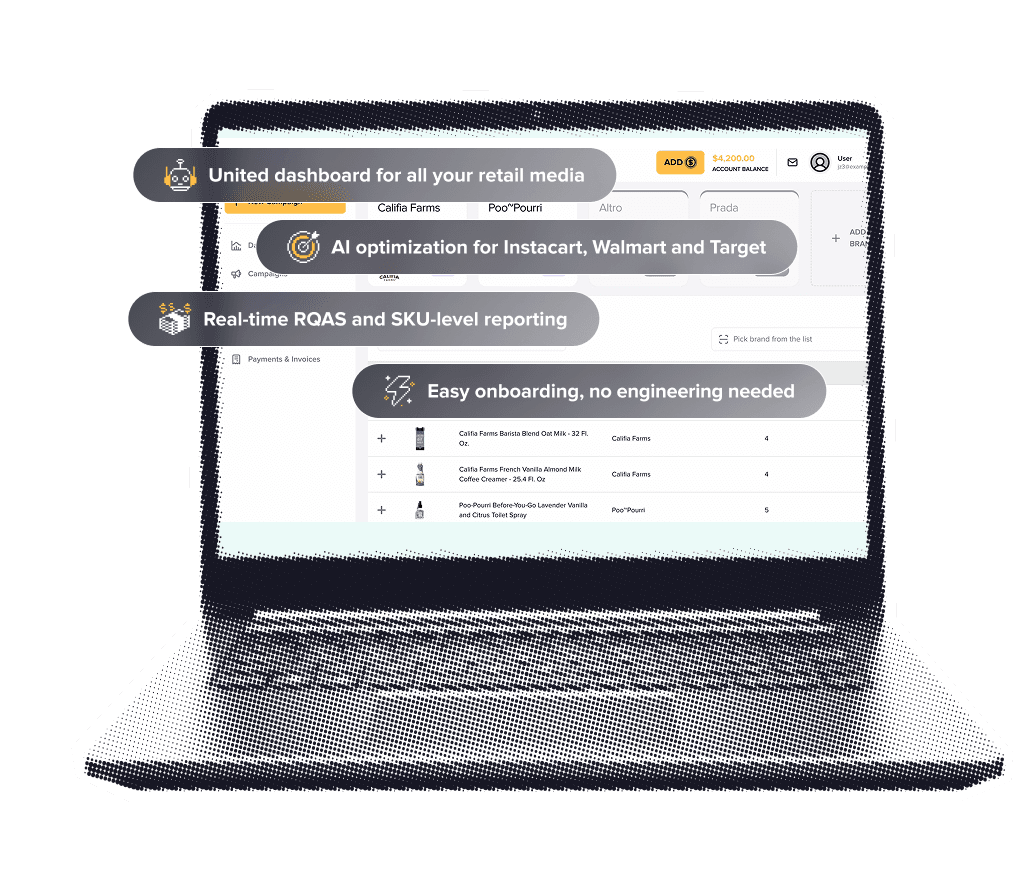
RMIQ streamlines pixels and tags across retail media networks by unifying deployment, governance, and optimization in a single platform, eliminating fragmented implementations for Walmart, Instacart, Amazon, Sprouts, Thrive Market, Target, and Uber while preserving clean, compliant data collection. Its multi‑agent AI automates critical tasks—mapping conversion events, deduplicating signals, right‑sizing lookback windows, harmonizing taxonomies across networks, and orchestrating A/B tests—to ensure tags fire accurately and attribution reflects true incremental performance. With SKU‑level intelligence and keyword context, RMIQ tunes pixel rules in real time, aligning bid and budget decisions with verified downstream behaviors so you maximize ROAS and reduce wasted spend from noisy or misfiring tags. The platform supports client‑side and server‑side tagging, leverages first‑party data securely, and enforces consent, privacy, and data retention policies, enabling enterprise‑grade compliance without compromising agility.
Prebuilt templates, QA guardrails, and continuous monitoring accelerate setup—often in under five minutes—while alerting teams to broken containers, missing events, or latency that could impair measurement. By consolidating dashboards, reporting, and workflow approvals, RMIQ removes the need for multiple log‑ins and manual reconciliations, delivering a single source of truth for pixel health, event coverage, and cross‑network attribution. Its adaptive agents learn from performance across more than twenty retail media platforms that reach up to 85% of the U.S. retail audience, refining tagging strategies alongside bids, budgets, and creatives to compound efficiency gains over time. Customers routinely see over 50% ROAS improvements and as much as five dollars in new sales for every dollar invested because decisioning is anchored to precise, de‑duplicated conversion data.
Whether you manage dozens or thousands of SKUs, RMIQ scales tagging operations with version control, sandboxing, and change logs, giving marketers and partners the confidence to iterate fast while safeguarding data quality and campaign performance. This drives durable growth, clearer insights, and tighter governance across complex portfolios globally.
Prebuilt templates, QA guardrails, and continuous monitoring accelerate setup—often in under five minutes—while alerting teams to broken containers, missing events, or latency that could impair measurement. By consolidating dashboards, reporting, and workflow approvals, RMIQ removes the need for multiple log‑ins and manual reconciliations, delivering a single source of truth for pixel health, event coverage, and cross‑network attribution. Its adaptive agents learn from performance across more than twenty retail media platforms that reach up to 85% of the U.S. retail audience, refining tagging strategies alongside bids, budgets, and creatives to compound efficiency gains over time. Customers routinely see over 50% ROAS improvements and as much as five dollars in new sales for every dollar invested because decisioning is anchored to precise, de‑duplicated conversion data.
Whether you manage dozens or thousands of SKUs, RMIQ scales tagging operations with version control, sandboxing, and change logs, giving marketers and partners the confidence to iterate fast while safeguarding data quality and campaign performance. This drives durable growth, clearer insights, and tighter governance across complex portfolios globally.

Skills and tools for Pixels/Tags
You need skills in JavaScript and HTML to implement pixels and tags. Familiarity with tag management tools like Google Tag Manager is essential. Understanding analytics platforms like Google Analytics helps analyze collected data. Basic knowledge of data privacy laws is also important.
Our Current Partners
We are already helping leading retailers and platforms grow their retail media businesses, including:
Drop your email
and we’ll show you how to double your retail media ROAS – no strings attached