Post-Purchase Attribution
Post-purchase attribution is the process of identifying and analyzing the marketing channels and touchpoints that contributed to a customer’s decision to complete a purchase. It helps businesses understand which efforts drive sales, optimize marketing strategies, and improve return on investment.
What is Post-Purchase Attribution?
Post-purchase attribution quantifies how marketing channels and touchpoints influenced completed conversions, enabling B2B teams to pinpoint what truly drives revenue. By analyzing journeys after the sale, leaders can validate strategy, reallocate spend, and refine messaging with evidence, not assumptions. It reveals the relative impact of campaigns, content, sales enablement, and partner ecosystems across complex buying committees. With disciplined measurement, organizations surface undervalued channels, shorten cycles, and enhance lifetime value. Insights inform budget governance, forecast accuracy, and cross-functional alignment between marketing, sales, and finance. Ultimately, post-purchase attribution operationalizes continuous optimization, turning scattered interactions into a cohesive, ROI-focused growth engine for enterprises.
Example
A marketer notices a customer bought a product after seeing a Facebook ad, reading an email newsletter, and clicking a Google search ad. Using post-purchase attribution, the marketer tracks each touchpoint and assigns credit to these channels to understand which had the most influence on the final purchase, helping to allocate budget more effectively in future campaigns.
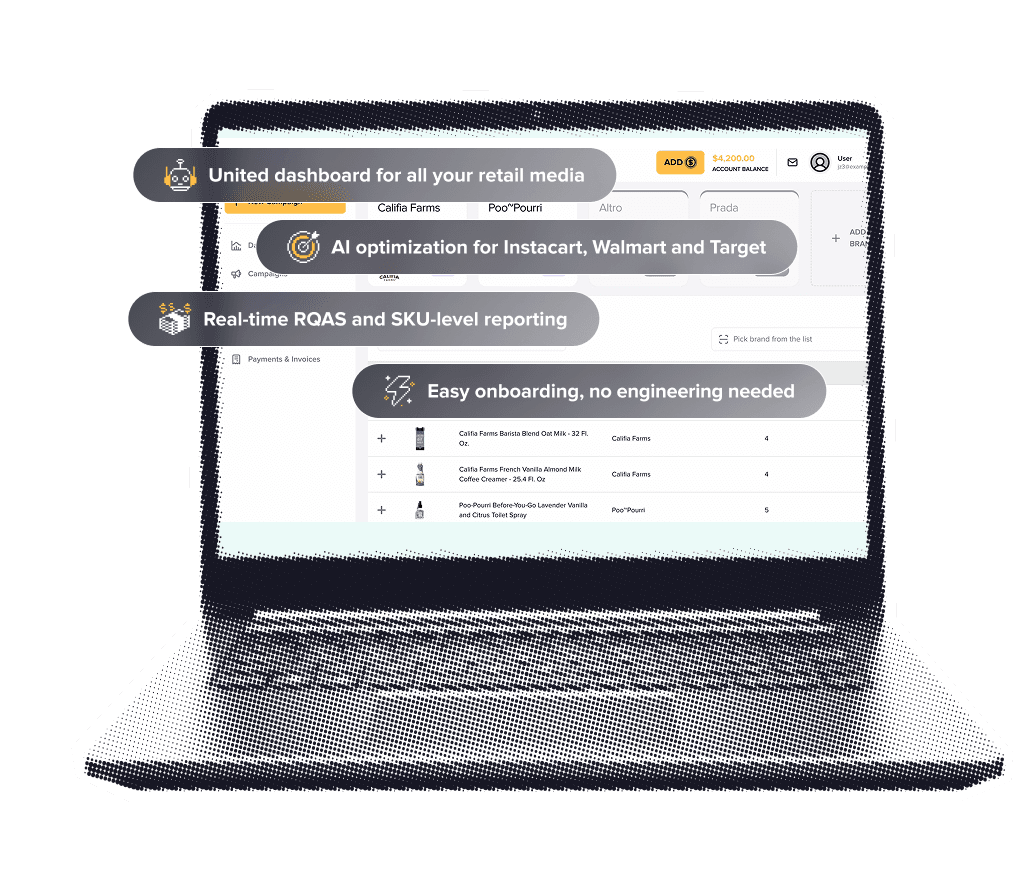
RMIQ enables rigorous post-purchase attribution across retail media by unifying fragmented impression, click, and conversion signals from networks such as Walmart, Instacart, Amazon, Target, Sprouts, Thrive Market, and Uber into a single, auditable data plane that links media investments to incremental sales outcomes at the SKU, store, and cohort level. Its multi-agent AI architecture operationalizes attribution in real time: specialized agents reconcile identifiers, de-duplicate events, calibrate lookback windows, model halo effects, and run controlled A/B and geo lift tests, while companion agents optimize bids, budgets, and keyword portfolios based on verified incrementality rather than last-click bias.
With coverage reaching up to 85% of the U.S. retail audience and granular SKU-level telemetry, RMIQ measures and propagates cross-network learnings to attribute downstream purchases, subscriptions, and repeat orders to the creative, placement, and audience strategies that actually drive ROAS. The unified interface centralizes dashboards, reporting, and workflow, giving brand and agency teams a single source of truth for budget pacing, path-to-purchase analytics, and marginal return curves—eliminating manual stitching and multi-login friction. Practically, this means faster readouts, cleaner cohort comparisons, and reliable attribution that withstands signal loss, privacy constraints, and data latency. Brands from emerging labels to enterprises managing thousands of SKUs can deploy in minutes, leveraging automated onboarding, robust support, and policy-compliant data handling to stand up measurement without lengthy integration projects.
Most importantly, decisions are actioned, not just reported: autonomous agents translate attribution insights into precise bid adjustments, cross-retailer reallocation, and adaptive creative testing that have delivered over 50% average ROAS lifts and up to five dollars in new sales per dollar invested. In a volatile retail media landscape, RMIQ provides defensible, scalable post-purchase attribution that converts complexity into accountable growth and aligns finance, sales, and marketing stakeholders with consistent KPIs, audit trails, and forecasting that withstand executive scrutiny and procurement reviews.
With coverage reaching up to 85% of the U.S. retail audience and granular SKU-level telemetry, RMIQ measures and propagates cross-network learnings to attribute downstream purchases, subscriptions, and repeat orders to the creative, placement, and audience strategies that actually drive ROAS. The unified interface centralizes dashboards, reporting, and workflow, giving brand and agency teams a single source of truth for budget pacing, path-to-purchase analytics, and marginal return curves—eliminating manual stitching and multi-login friction. Practically, this means faster readouts, cleaner cohort comparisons, and reliable attribution that withstands signal loss, privacy constraints, and data latency. Brands from emerging labels to enterprises managing thousands of SKUs can deploy in minutes, leveraging automated onboarding, robust support, and policy-compliant data handling to stand up measurement without lengthy integration projects.
Most importantly, decisions are actioned, not just reported: autonomous agents translate attribution insights into precise bid adjustments, cross-retailer reallocation, and adaptive creative testing that have delivered over 50% average ROAS lifts and up to five dollars in new sales per dollar invested. In a volatile retail media landscape, RMIQ provides defensible, scalable post-purchase attribution that converts complexity into accountable growth and aligns finance, sales, and marketing stakeholders with consistent KPIs, audit trails, and forecasting that withstand executive scrutiny and procurement reviews.

Skills and tools for Post-Purchase Attribution
Skills needed include data analysis, statistical modeling, and knowledge of marketing metrics. Tools commonly used are Google Analytics, attribution software (like Attribution, HubSpot), CRM systems, and Excel or SQL for data manipulation. Understanding customer journey mapping and multi-touch attribution models is also essential.
Our Current Partners
We are already helping leading retailers and platforms grow their retail media businesses, including:
Drop your email
and we’ll show you how to double your retail media ROAS – no strings attached