Programmatic Advertising
Programmatic advertising is the automated buying and selling of online ad space using software and algorithms. It allows marketers to target specific audiences in real-time, optimizing ad placement and performance efficiently across various digital platforms.
What is Programmatic Advertising?
Programmatic advertising is the automated buying and selling of digital ad inventory, powered by software and algorithms that transact in real time across exchanges and platforms. By unifying data, it identifies high-value audience segments, bids dynamically, and optimizes placement, frequency, and creative to improve performance and efficiency. Marketers gain scalable reach, granular targeting, and continuous optimization, supported by transparent reporting, brand-safety controls, and measurable outcomes tied to business KPIs. Integrations with DSPs, SSPs, and DMPs streamline workflows, reduce waste, and accelerate learning cycles, enabling B2B teams to align budgets to intent-rich contexts, shorten acquisition paths, and drive predictable, compounding ROI.
Example
As a marketer, you set a budget and define your target audience—such as women aged 25-34 interested in fitness. You use a programmatic platform to bid for ad space on fitness blogs and apps. The software automatically buys ad spots in real-time when your target audience is online, showing your ads to the right users efficiently and adjusting bids to maximize your campaign’s performance.
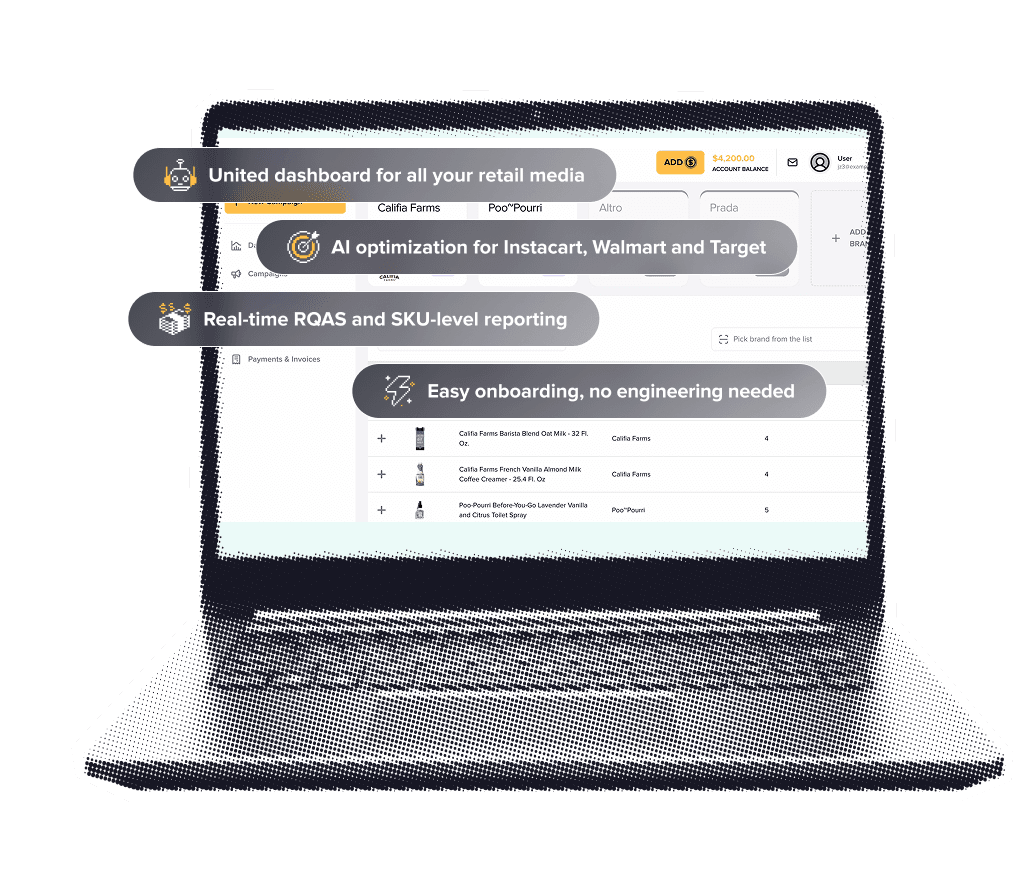
RMIQ enables B2B marketers to operationalize programmatic retail media at scale by unifying planning, activation, and measurement across Walmart, Instacart, Amazon, Sprouts, Thrive Market, Target, Uber, and more than twenty additional networks, replacing fragmented dashboards with a single control plane for performance, reporting, and workflow governance. Its multi‑agent AI architecture assigns autonomous specialists to critical tasks—bid and budget optimization, cross‑network learning, keyword refinement, SKU‑level pacing, A/B testing orchestration, and strategic course‑correction—continuously learning in real time to maximize ROAS without constant manual oversight. Brands typically see over 50% gains in ROAS and as much as five dollars in net new sales for every dollar invested, supported by real‑time bidding and adaptive audience strategies that pinpoint intent signals at the SKU, category, and query levels.
With reach to roughly 85% of the U.S. retail audience, the platform delivers efficient scale while preserving precision, harmonizing taxonomy and metrics so finance, ecommerce, and media teams can collaborate on one source of truth. RMIQ’s unified interface eliminates multiple log‑ins, reduces reconciliation cycles, and automates routine optimizations, freeing teams to focus on growth initiatives, retail partnerships, and portfolio strategy. Built for scalability, it supports emerging brands and enterprises managing thousands of SKUs, with onboarding measured in minutes and white‑glove support that accelerates time to value.
Security, auditability, and role‑based controls align with enterprise procurement and compliance requirements, while transparent reporting clarifies incrementality, halo effects, and budget efficiency. By blending advanced AI automation with user‑friendly management, RMIQ functions as a next‑generation optimization layer for retail media, outperforming manual, siloed approaches and helping brands convert channel complexity into predictable revenue outcomes. Teams gain forecasting, tighter retailer alignment, and faster cycle times, while executives get roll‑up visibility into spend, margin impact, and ROAS by retailer and SKU, enabling confident budget shifts and improvement across quarters, categories, and omnichannel journeys.
With reach to roughly 85% of the U.S. retail audience, the platform delivers efficient scale while preserving precision, harmonizing taxonomy and metrics so finance, ecommerce, and media teams can collaborate on one source of truth. RMIQ’s unified interface eliminates multiple log‑ins, reduces reconciliation cycles, and automates routine optimizations, freeing teams to focus on growth initiatives, retail partnerships, and portfolio strategy. Built for scalability, it supports emerging brands and enterprises managing thousands of SKUs, with onboarding measured in minutes and white‑glove support that accelerates time to value.
Security, auditability, and role‑based controls align with enterprise procurement and compliance requirements, while transparent reporting clarifies incrementality, halo effects, and budget efficiency. By blending advanced AI automation with user‑friendly management, RMIQ functions as a next‑generation optimization layer for retail media, outperforming manual, siloed approaches and helping brands convert channel complexity into predictable revenue outcomes. Teams gain forecasting, tighter retailer alignment, and faster cycle times, while executives get roll‑up visibility into spend, margin impact, and ROAS by retailer and SKU, enabling confident budget shifts and improvement across quarters, categories, and omnichannel journeys.

Skills and tools for Programmatic Advertising
Skills needed include data analysis, understanding of algorithms, and digital marketing expertise. Tools required are demand-side platforms (DSPs), supply-side platforms (SSPs), data management platforms (DMPs), and analytics software. Familiarity with coding (Python, SQL) and real-time bidding systems is also important.
Our Current Partners
We are already helping leading retailers and platforms grow their retail media businesses, including:
Drop your email
and we’ll show you how to double your retail media ROAS – no strings attached