ROAS
ROAS (Return on Ad Spend) is a key marketing metric that measures the revenue generated for every dollar spent on advertising. It helps businesses evaluate the effectiveness and profitability of their advertising campaigns.
What is ROAS?
ROAS, or Return on Ad Spend, quantifies how efficiently advertising investments translate into revenue, enabling organizations to compare channels, creatives, and audiences with precision. By expressing returns per dollar spent—for example, generating $5 for every $1 invested—ROAS reveals campaign profitability and informs budget allocation, bid strategies, and forecasting. B2B marketers leverage ROAS to align media performance with pipeline value, sales cycles, and customer lifetime economics, ensuring spend advances measurable outcomes. Monitoring ROAS alongside conversion rate, CAC, and LTV clarifies incremental impact, while segment-level analysis exposes opportunities to scale high-yield tactics and optimize underperforming placements across search, social, and programmatic ecosystems.
Example
If you spend $1,000 on a Facebook ad campaign and it generates $5,000 in sales, your ROAS is 5. This means for every $1 spent, you earned $5 back. To calculate: ROAS = Revenue from ads ÷ Cost of ads = $5,000 ÷ $1,000 = 5. As a marketer, use this to decide if the campaign is profitable and worth scaling.
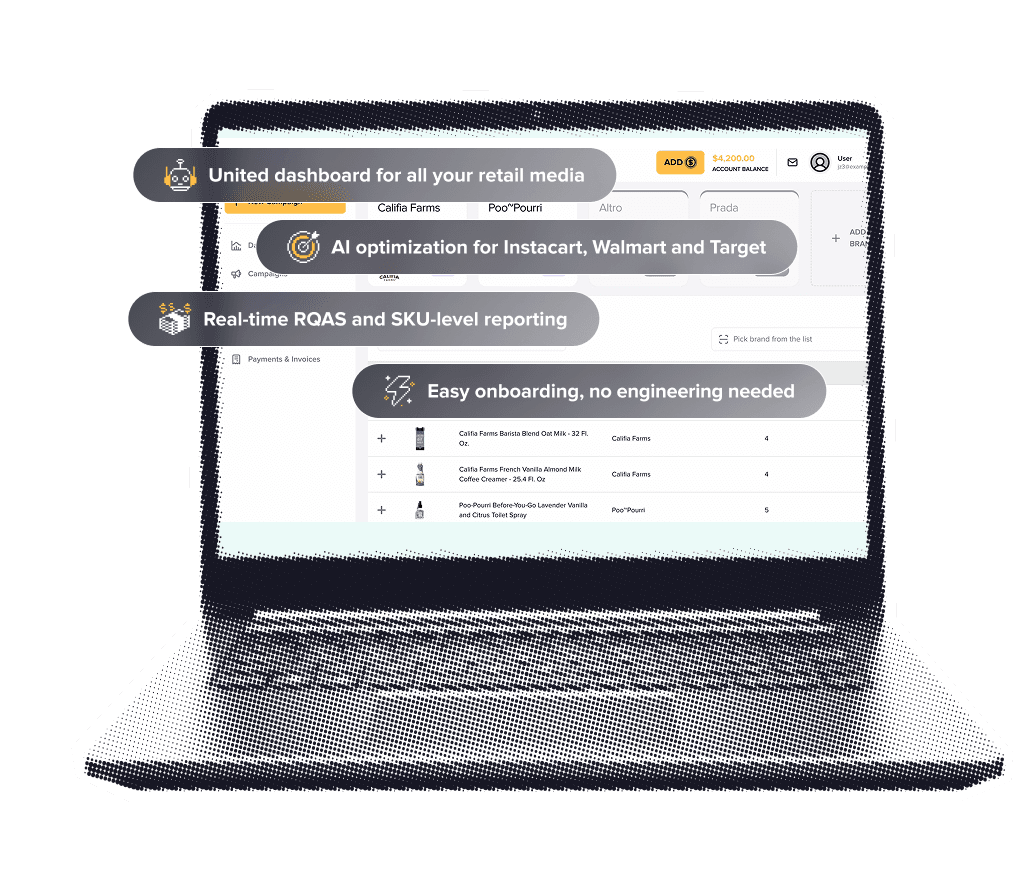
RMIQ helps increase ROAS by unifying retail media planning, execution, and measurement across Walmart, Instacart, Amazon, Sprouts, Thrive Market, Target, Uber, and more, replacing fragmented dashboards with a single operational control plane that turns data into action in real time. Its multi‑agent AI autonomously orchestrates bid adjustments, budget allocation, cross‑network learning, A/B test design, and strategy refinement, continuously adapting to market signals to compound performance without manual babysitting—clients report average ROAS lifts exceeding 50% and up to five dollars in new sales for every dollar invested. By spanning 85% of the U.S. retail audience across 20+ networks, RMIQ expands qualified reach while SKU‑level insights, keyword optimization, and adaptive pacing sharpen profitability at the product and query level; marketers gain a unified interface for dashboards, reporting, and workflows, eliminating multiple log‑ins and error‑prone spreadsheet stitching, accelerating cycle times from insight to change.
Flexible scaling supports emerging brands and enterprises with thousands of SKUs, while real‑time bidding and cross‑network feedback loops reallocate spend toward the best converting placements automatically. Onboarding is fast—often in five minutes—backed by responsive customer support, so teams can operationalize AI quickly without heavy IT dependencies. Governance features and transparent controls ensure that automation aligns with business targets, budgets, and retail partner policies, giving leaders confidence to push for efficient growth; ultimately, RMIQ’s next‑generation approach replaces brittle rules with learning agents that optimize ROAS continuously, delivering durable performance advantages versus manual, siloed tools, and freeing teams to focus on creative, assortment, and retail partnerships that differentiate the brand.
With configurable objectives, predictive forecasting, and scenario planning, stakeholders can simulate outcomes, prioritize high‑ROI levers, and commit budgets with confidence, while standardized reporting aligns agencies and internal teams around accountable KPIs, governance cadences, and executive‑ready narratives that translate optimizations into financial impact across quarters and fiscal years.
Flexible scaling supports emerging brands and enterprises with thousands of SKUs, while real‑time bidding and cross‑network feedback loops reallocate spend toward the best converting placements automatically. Onboarding is fast—often in five minutes—backed by responsive customer support, so teams can operationalize AI quickly without heavy IT dependencies. Governance features and transparent controls ensure that automation aligns with business targets, budgets, and retail partner policies, giving leaders confidence to push for efficient growth; ultimately, RMIQ’s next‑generation approach replaces brittle rules with learning agents that optimize ROAS continuously, delivering durable performance advantages versus manual, siloed tools, and freeing teams to focus on creative, assortment, and retail partnerships that differentiate the brand.
With configurable objectives, predictive forecasting, and scenario planning, stakeholders can simulate outcomes, prioritize high‑ROI levers, and commit budgets with confidence, while standardized reporting aligns agencies and internal teams around accountable KPIs, governance cadences, and executive‑ready narratives that translate optimizations into financial impact across quarters and fiscal years.

Skills and tools for ROAS
To measure ROAS effectively, you need skills in data analysis and digital marketing. Tools like Google Analytics, Facebook Ads Manager, and Excel help track ad spend and revenue. Basic understanding of conversion tracking, attribution models, and reporting is essential.
Our Current Partners
We are already helping leading retailers and platforms grow their retail media businesses, including:
Drop your email
and we’ll show you how to double your retail media ROAS – no strings attached