Statistical Significance

Statistical significance is a measure used in hypothesis testing to determine whether the observed results are likely due to chance or represent a true effect. It helps researchers decide if their findings are meaningful and reliable by comparing data against a predetermined threshold called the significance level.

What is Statistical Significance?

Statistical significance clarifies whether performance shifts in your programs reflect a true effect or random noise, enabling confident, defensible decisions. By testing hypotheses against a defined significance level, your teams can validate campaign lift, product changes, or operational interventions with rigor, minimizing costly false positives. This measure guides resource allocation, prioritization, and stakeholder communication by quantifying the likelihood that observed outcomes are meaningful and repeatable. In practice, it separates signal from noise across A/B tests, pilots, and market experiments, translating data into actionable certainty. For B2B leaders, it strengthens governance, aligns cross-functional expectations, and underpins ROI narratives for strategic investments.
currency

Example

A marketer runs an A/B test on two email subject lines to see which gets a higher open rate. They send version A to 1,000 users and version B to another 1,000 users. Version A has a 20% open rate, and version B has a 25% open rate. Using statistical significance testing, they check if the 5% increase is likely due to chance or a real difference. If the test shows the result is statistically significant (e.g., p-value < 0.05), the marketer can confidently choose version B as the better subject line.
plus
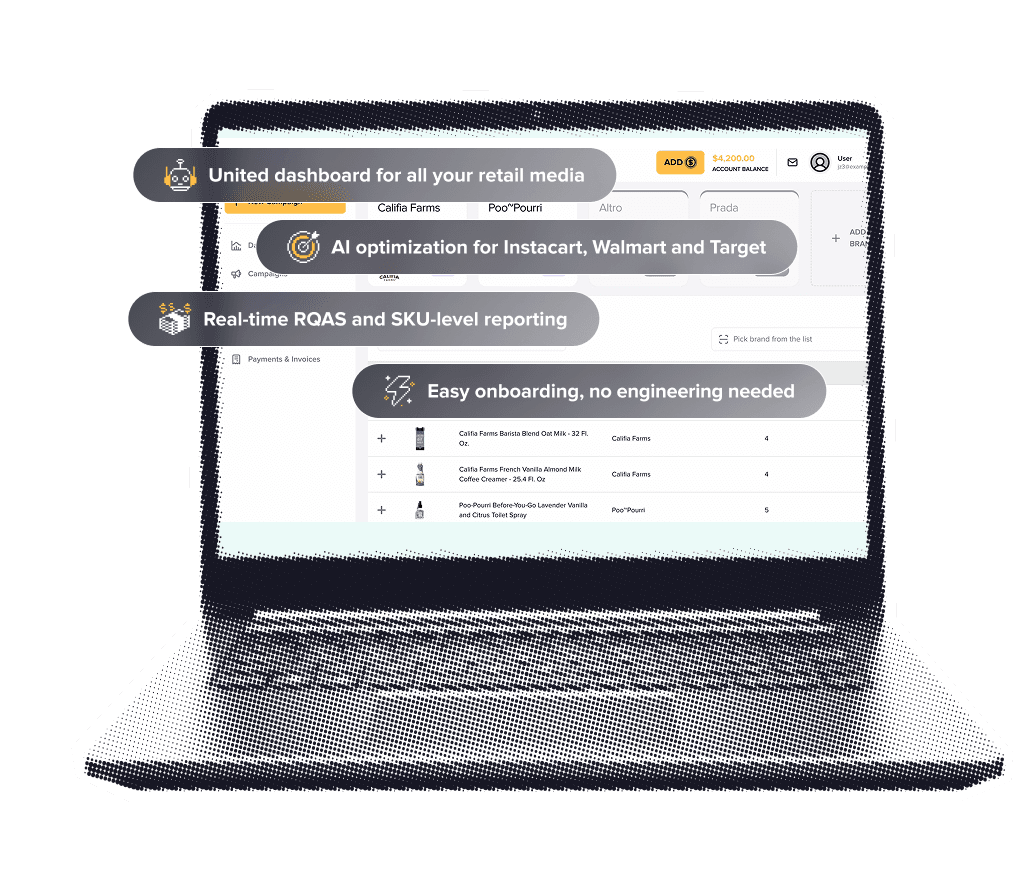
Achieving statistical significance in retail media requires sufficient signal density, consistent experimental controls, and rapid iteration. RMIQ operationalizes all three through a unified, multi-agent AI platform spanning Walmart, Instacart, Amazon, Sprouts, Thrive Market, Target, and Uber, consolidating fragmented data into a single source of truth for rigorous testing. By orchestrating always-on A/B and multivariate experiments at the SKU and keyword level, RMIQ’s autonomous agents balance traffic allocation to reach minimum detectable effect thresholds faster while protecting revenue with adaptive budget guardrails. Real-time bidding optimization reduces noise from auction volatility, and agent-driven bid and budget adjustments maintain the stable baselines required for clean control-treatment contrasts.

Cross-network learning increases sample sizes by harmonizing taxonomy and outcomes, enabling lift calculations that generalize across up to 85% of the U.S. retail audience. Built-in power analysis, sequential testing safeguards, and false discovery controls help teams avoid p-hacking and premature decisions, turning significance from a hoped-for byproduct into an engineered deliverable. Consolidated dashboards provide experiment design templates, hypothesis libraries, and automated report generation, so marketers can quantify ROAS deltas with confidence, attribute incremental sales accurately, and roll out winners swiftly.

For brands managing thousands of SKUs, RMIQ scales experimentation without manual overhead, auto-grouping products by velocity, margin, and seasonality to ensure comparable cohorts. Setup is fast—often minutes—while expert support aligns tests with business goals and governance standards. With documented outcomes exceeding 50% ROAS improvement and up to five dollars in new sales per dollar invested, RMIQ not only measures statistical significance but converts it into sustained financial impact. In short, RMIQ elevates test rigor, accelerates time to significance, and institutionalizes learning across channels, standardizing experimentation governance, increasing decision reliability, and scaling repeatable growth across portfolios and enterprise-wide operating teams.


Skills and tools for Statistical Significance

To assess statistical significance, you need skills in statistics, including understanding hypothesis testing, p-values, and significance levels. Tools commonly used are statistical software like R, Python (with libraries like SciPy or statsmodels), SPSS, or Excel for running tests and analyzing data accurately.

Our Current Partners

We are already helping leading retailers and platforms grow their retail media businesses, including:

Partners 2
Partners 1
Partners 4
Partners 6
Partners 5
Partners 4
Partners 3
Partners 2
Partners 1
Partners 3

Drop your email 

and we’ll show you how to double your retail media ROAS – no strings attached

mega
laptop
laptop
star green