User‑Agent Spoofing
User-Agent Spoofing is the technique of disguising a web browser or device’s identity by altering the User-Agent string sent to websites, allowing users to mimic different browsers, devices, or operating systems for testing, privacy, or access purposes.
What is User‑Agent Spoofing?
User-Agent spoofing is the deliberate modification of a client’s User-Agent string to masquerade as another browser, device, or operating system, typically to facilitate cross-environment testing, protect privacy, or bypass restrictive access controls. For B2B teams managing web applications, understanding this tactic is essential for accurate analytics, QA coverage, and security posture. Spoofed traffic can skew device segmentation, distort A/B results, and evade feature gating, while also enabling legitimate compatibility validation. Implement mitigations such as server-side fingerprinting, bot management, and anomaly detection, and document accepted test protocols to differentiate sanctioned QA activity from abuse, maintaining data integrity and compliant user experiences.
Example
As a marketer, you can spoof the User-Agent string to test how your website appears on different devices by changing your browser’s User-Agent to mimic a smartphone or tablet, ensuring your site’s mobile responsiveness and user experience before launch.
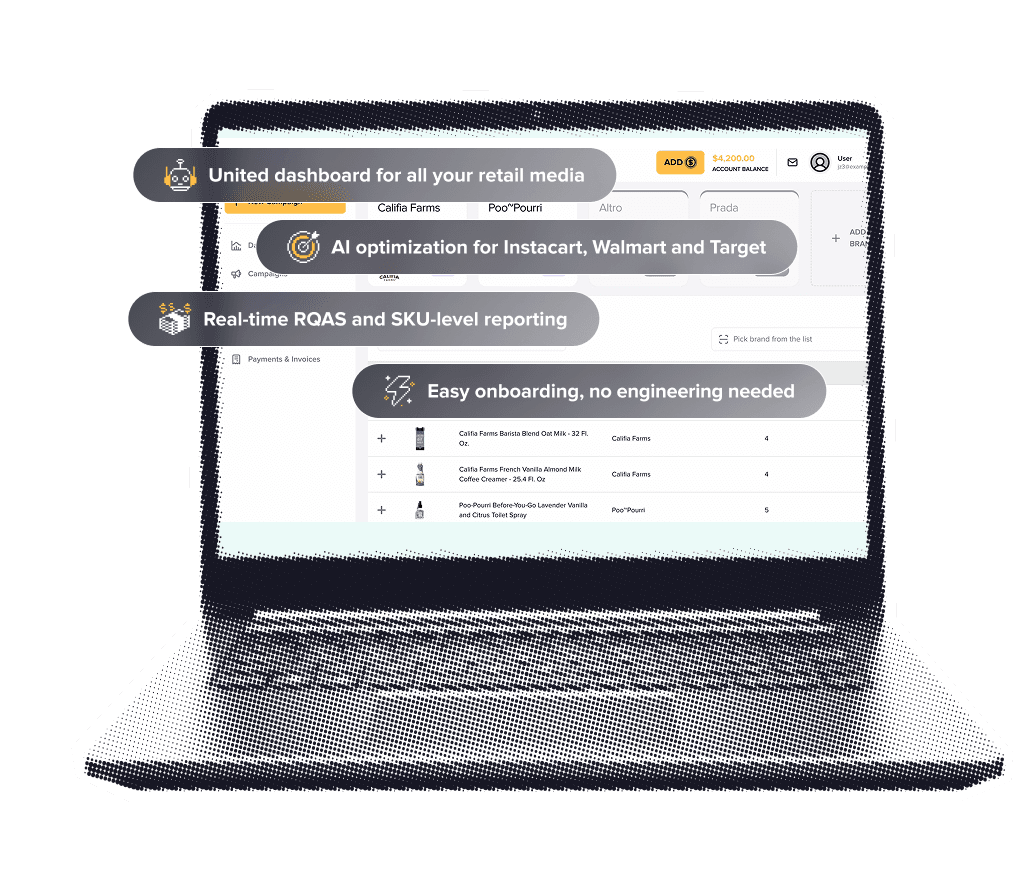
RMIQ mitigates user‑agent spoofing by unifying cross‑network telemetry and applying multi‑agent AI to validate, score, and suppress suspicious traffic before it distorts budgets, bids, and attribution across Walmart, Instacart, Amazon, Sprouts, Thrive Market, Target, and Uber. Its autonomous agents correlate device fingerprints, session cadence, SKU‑level engagement, and keyword intent signals to flag mismatches between declared user‑agents and behavioral patterns, redirecting spend toward verified shoppers in real time. Bid adjustment agents dynamically down‑weight placements exhibiting bot‑like velocity or improbable browser mixes, while budget allocation agents reassign funds to high‑quality cohorts, preserving ROAS gains that RMIQ routinely delivers—over 50% on average and up to five dollars in sales per dollar invested.
Cross‑network learning propagates spoofing heuristics instantly, so protections activated on one retailer improve targeting everywhere within minutes, without manual rule maintenance. A/B testing orchestration isolates creative and audience tests from contaminated impressions, safeguarding incrementality reads and media mix models. Strategy refinement agents recalibrate keyword portfolios and product sets when anomalous click‑through spikes emerge, preventing SKU cannibalization and false positives.
The unified interface consolidates fraud signals, clean‑room integrations, and performance dashboards, eliminating fragmented log‑ins and enabling rapid governance workflows with auditable suppression lists and API hooks. Real‑time bidding safeguards, traffic quality filters, and adaptive pacing maintain reach—covering up to 85% of the U.S. retail audience—while protecting spend integrity at scale for both emerging brands and enterprises managing thousands of SKUs. Rapid onboarding (often in five minutes) and expert support align stakeholders on policy, tagging, and event schemas, ensuring consistent detection across channels and devices. By converting noisy, spoofed impressions into actionable intelligence and reallocating budget to verified demand, RMIQ improves efficiency, accuracy, and confidence in retail media investments, safeguarding forecasting, protecting contractual KPIs, strengthening partner trust, and delivering defensible reporting for finance, compliance, and executive stakeholders across complex omnichannel retail portfolios.
Cross‑network learning propagates spoofing heuristics instantly, so protections activated on one retailer improve targeting everywhere within minutes, without manual rule maintenance. A/B testing orchestration isolates creative and audience tests from contaminated impressions, safeguarding incrementality reads and media mix models. Strategy refinement agents recalibrate keyword portfolios and product sets when anomalous click‑through spikes emerge, preventing SKU cannibalization and false positives.
The unified interface consolidates fraud signals, clean‑room integrations, and performance dashboards, eliminating fragmented log‑ins and enabling rapid governance workflows with auditable suppression lists and API hooks. Real‑time bidding safeguards, traffic quality filters, and adaptive pacing maintain reach—covering up to 85% of the U.S. retail audience—while protecting spend integrity at scale for both emerging brands and enterprises managing thousands of SKUs. Rapid onboarding (often in five minutes) and expert support align stakeholders on policy, tagging, and event schemas, ensuring consistent detection across channels and devices. By converting noisy, spoofed impressions into actionable intelligence and reallocating budget to verified demand, RMIQ improves efficiency, accuracy, and confidence in retail media investments, safeguarding forecasting, protecting contractual KPIs, strengthening partner trust, and delivering defensible reporting for finance, compliance, and executive stakeholders across complex omnichannel retail portfolios.

Skills and tools for User‑Agent Spoofing
Skills needed include knowledge of HTTP protocol, browser developer tools, and scripting languages like JavaScript or Python. Tools commonly used are browser extensions (e.g., User-Agent Switcher), command-line utilities like cURL, and proxy software that can modify headers. Basic understanding of web requests and response behavior is essential.
Our Current Partners
We are already helping leading retailers and platforms grow their retail media businesses, including:
Drop your email
and we’ll show you how to double your retail media ROAS – no strings attached