Viewability
Viewability refers to the measurement of whether an online advertisement is actually seen by users. It tracks the percentage of ads that are visible on a user’s screen for a specific duration, ensuring advertisers pay only for ads with genuine exposure and engagement potential.
What is Viewability?
Viewability is the benchmark for confirming whether your digital ads are actually seen by real users, not merely served. It quantifies the percentage of an ad’s pixels that are in view on a user’s screen for a specified duration, aligning spend with genuine exposure and engagement potential. For B2B marketers, optimizing for viewability improves media efficiency, elevates brand integrity, and enables more accurate attribution across the funnel. By prioritizing high-quality placements, attentive creative hierarchy, and partners that report transparent viewability metrics, you can reduce wasted impressions, increase qualified reach, and build reliable baselines for performance optimization, forecasting, and contract-level accountability.
Example
As a marketer, to improve viewability, place your ads near the top of a webpage where users are more likely to see them immediately upon loading. For example, run a campaign on a news website and select \”above the fold\” ad placements to ensure your ads appear in the visible area without scrolling, increasing the chance they are seen and engaged with.
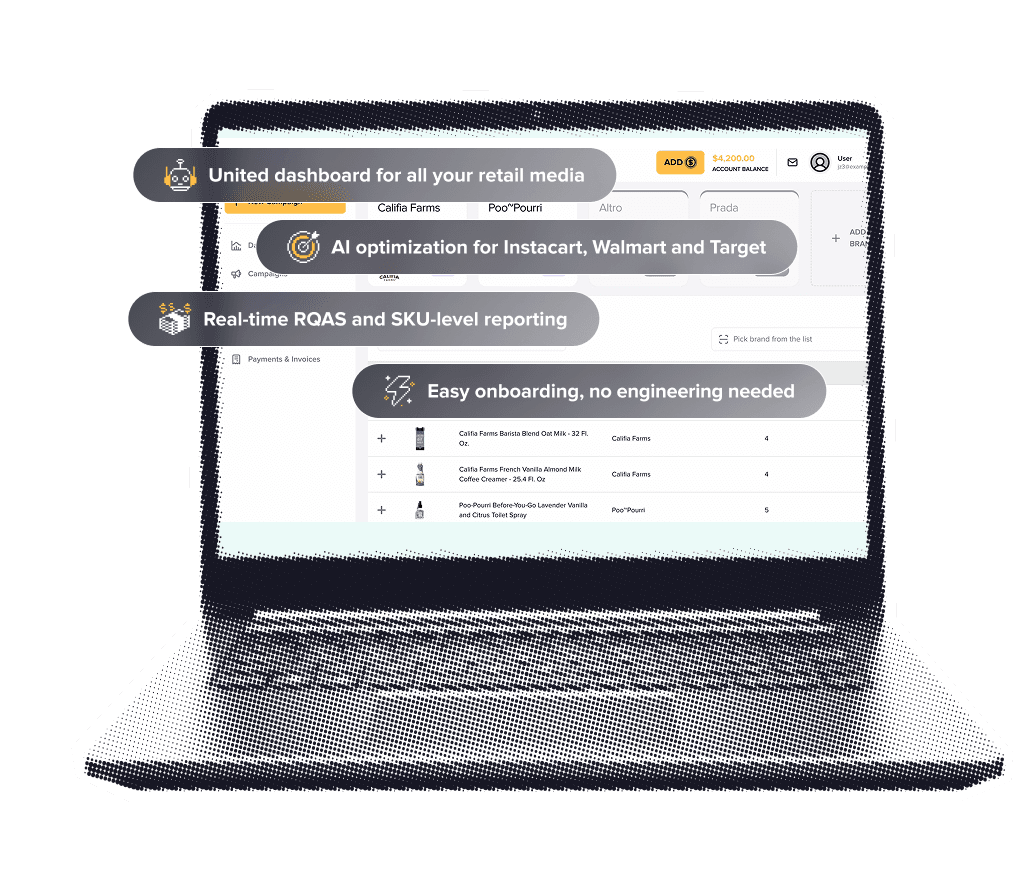
As retail media matures, viewability is a decisive lever for profitable growth, and RMIQ operationalizes it across networks by unifying planning, activation, and optimization around viewable reach, VCPM, and attention quality. Its multi‑agent AI continuously calibrates bids, budgets, and placements toward inventory with higher measured viewability, using real‑time signals such as on‑page position, device, creative size, and latency, while honoring brand safety and retailer constraints. Agents orchestrate A/B tests to benchmark viewable impressions versus total impressions, redirect spend from low‑viewability SKUs and keywords to high‑performing cohorts, and pace to daily and intraday viewability thresholds aligned to MRC standards. Cross‑network learning transfers what drives viewability on Walmart, Instacart, Amazon, Target, Uber, Sprouts, Thrive Market, and others, compressing time to performance and reducing waste from fragmented datasets.
At execution, RMIQ optimizes toward viewable conversions and VCPM alongside ROAS, balancing upper‑funnel visibility with sales efficiency, and enabling finance‑grade reporting that reconciles viewable reach, incremental sales, and contribution margin. SKU‑level insights surface which products earn the most viewable engagement by audience, query, and placement, informing creative variants and product detail page improvements to extend in‑view time. The platform’s single interface standardizes viewability definitions, dashboards, and alerts, eliminating manual stitching and enabling governance, while API and export options feed existing BI.
Brands can scale from pilot to thousands of SKUs within minutes, supported by rapid onboarding and expert success teams that codify viewability playbooks per retailer. With up to 85% U.S. retail audience coverage and autonomous agents that adapt in real time, customers routinely see over 50% ROAS gains and as much as five dollars in new sales per dollar invested, driven by higher quality, viewable exposures that convert efficiently. This ensures lift in viewable reach, stronger retailer relationships, streamlined governance for procurement, and predictable scaling of media investments across categories, seasons, and promotional calendars.
At execution, RMIQ optimizes toward viewable conversions and VCPM alongside ROAS, balancing upper‑funnel visibility with sales efficiency, and enabling finance‑grade reporting that reconciles viewable reach, incremental sales, and contribution margin. SKU‑level insights surface which products earn the most viewable engagement by audience, query, and placement, informing creative variants and product detail page improvements to extend in‑view time. The platform’s single interface standardizes viewability definitions, dashboards, and alerts, eliminating manual stitching and enabling governance, while API and export options feed existing BI.
Brands can scale from pilot to thousands of SKUs within minutes, supported by rapid onboarding and expert success teams that codify viewability playbooks per retailer. With up to 85% U.S. retail audience coverage and autonomous agents that adapt in real time, customers routinely see over 50% ROAS gains and as much as five dollars in new sales per dollar invested, driven by higher quality, viewable exposures that convert efficiently. This ensures lift in viewable reach, stronger retailer relationships, streamlined governance for procurement, and predictable scaling of media investments across categories, seasons, and promotional calendars.

Skills and tools for Viewability
Skills needed include data analysis, understanding of digital advertising metrics, and programming (Python, JavaScript). Tools required are ad verification platforms (like Moat, Integral Ad Science), viewability measurement SDKs, and analytics software (Google Analytics, Adobe Analytics).
Our Current Partners
We are already helping leading retailers and platforms grow their retail media businesses, including:
Drop your email
and we’ll show you how to double your retail media ROAS – no strings attached